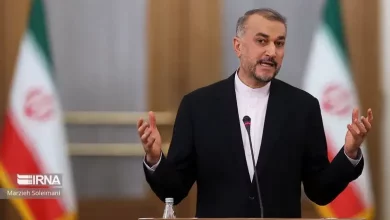
Tehran Declares ‘Real Regional War’ with ‘israel’ in Progress, Rejects US Dialogue
The spokesperson for Iran's Foreign Ministry has declared that the region is in the throes of "a real war" involving the Israeli government, highlighting that the circumstances have escalated well beyond mere threats.
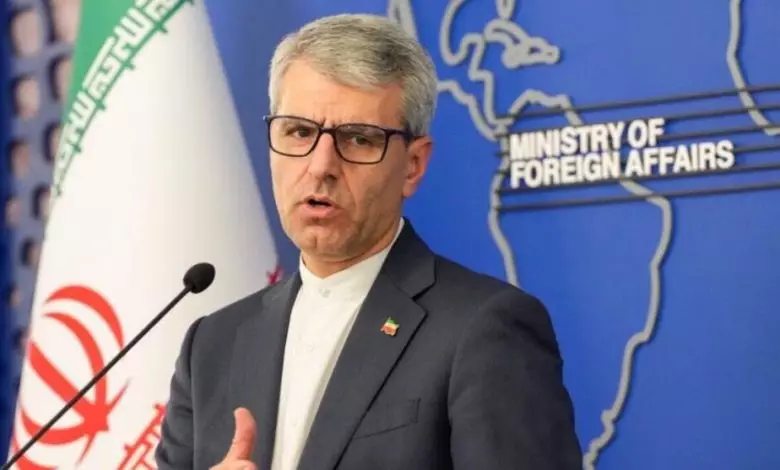
In a weekly press conference held in Tehran on Monday, Esmaeil Baghaei asserted that regional countries unanimously recognize the primary threat as emanating from the Zionist regime.
He elaborated further, stating that the term “threat” does not fully capture the situation, as they are engaged in an actual regional conflict with the Zionist regime.
He articulated that while a threat suggests the possibility of a future action, there has been, for over two years, a relentless and brutal assault on individuals in Palestine, alongside attacks on various neighboring countries and a continued occupation.
He highlighted that a strong regional consensus has emerged on two key issues: identifying the Israeli regime as the principal threat, and recognizing the necessity for countries within the region to pursue mutual understanding and agreements to safeguard their security.
A spokesperson commented on the current situation regarding the US-brokered ceasefire in Gaza, highlighting that although the phrase “ceasefire violation” is now being utilized, the situation on the ground remains unchanged and reflects “the ongoing genocide and collective destruction of Palestinians in both Gaza and the West Bank.”
He highlighted that since the initiation of ceasefire discussions, over 200 Palestinians have lost their lives and more than 600 have been wounded, attributing accountability to the guarantors of the truce.
Baghaei pointed to the alarming toll on journalists, with around 270 reportedly killed amid the Gaza conflict. He emphasized that this fact alone suggests that the events unfolding are not merely indicative of war, but rather a “full-scale genocide.”
He cautioned that the persistent inactivity of the UN Security Council, along with the backing from the regime’s main allies, has encouraged Israel, resulting in an ongoing perception of immunity concerning its continued, blatant breaches of human rights.
**”No Formal Communication from the U.S.,”**
In response to inquiries regarding discussions with the United States, Baghaei clarified that no formal communication had been transmitted from the American side through Oman.
He clarified that despite the ongoing efforts by intermediaries to facilitate message exchanges, this “in no way indicates the commencement of a negotiation process between Iran and the United States.”
“Iran experienced an assault amid diplomatic negotiations,” he remarked, referencing a US-Israeli action in June that resulted in the deaths of numerous senior military leaders, nuclear scientists, and civilians. “The Iranian people will never forget this incident,” he added.
He asserted that the United States has demonstrated a lack of commitment to the principles of fair negotiation, emphasizing that discussions can only be deemed viable when all parties involved are capable of acknowledging and respecting each other’s interests.
An Iranian diplomat has issued a scathing critique of the United States and Western nations over their “regrettable” and “hypocritical” approach to nuclear matters. The diplomat accused these countries of failing to adhere to their own commitments under the Non-Proliferation Treaty (NPT), all the while placing pressure on Iran’s peaceful nuclear program.
He highlighted a statement made by Trump regarding the United States’ arsenal, which reportedly has the capacity to “destroy the world 150 times over.” He questioned how such a capability could possibly be a source of pride.
In discussing US-Iran relations, Baghaei highlighted a recent regional summit where US Director of National Intelligence, Tulsi Gabbard, acknowledged that Washington has long engaged in interventions within other nations’ internal matters. Such actions, Gabbard conceded, have exacerbated hostility, division, and terrorism on a global scale.
He lamented that certain American politicians have not learned from past challenges and expressed optimism that the “atrocities and human tragedies unfolding in our region” would eventually receive attention and resolution on the international stage.
He highlighted recent developments in Syria, the continuing crisis in Sudan, and the turbulent conditions in Libya as examples of how such interventions have “only exacerbated instability and disorder.”
In a tragic development earlier this week, reports have surfaced that Sudan’s Rapid Support Forces (RSF) have carried out a massacre in El-Fasher, located in western Darfur, resulting in the deaths of at least 2,000 individuals.
Reports indicate alarming occurrences of summary executions, sexual violence, assaults on humanitarian workers, looting, and abductions. The extent of the violence is so severe that the traces of bloodshed are visible from space-based surveillance.
The Rapid Support Forces (RSF) have been engaged in a prolonged conflict with the Sudanese Armed Forces (SAF) for over two years.
Israel, the United Kingdom, France, Canada, and the United States are under heightened examination concerning their arms sales and diplomatic support.
Reports indicate that, despite official denials, the United Arab Emirates has become a significant supporter of the Rapid Support Forces (RSF) in Sudan. The UAE is alleged to be supplying weapons and logistical assistance in exchange for Sudanese gold.
The conflict has resulted in the death of more than 150,000 individuals, displaced 12 million people, and left nearly 25 million facing severe food insecurity.
**Use of Crime-Fighting as Justification for Breaching Sovereignty Deemed Unacceptable**
Iran has strongly condemned recent U.S. military maneuvers in the Caribbean and Latin America, labeling them as a threat to international peace and security. Baghaei expressed Tehran’s strong opposition to these actions, emphasizing their disruptive nature.
He stated that the justification of “combating drug trafficking” has been frequently employed in the region and “lacks legal legitimacy from an international law standpoint.”
He emphasized that no nation is allowed to infringe upon another’s territorial integrity and sovereignty simply under the pretext of combating transnational organized crimes, including drug trafficking and other offenses.
The growing military presence has sparked concerns that Washington could be aiming to destabilize or even invade Venezuela using contrived justifications.
The Southern Command has executed at least 15 operations in the Caribbean and the eastern Pacific since the beginning of September, resulting in a minimum of 62 fatalities.
In a national broadcast late last month, Venezuelan President Nicolas Maduro accused the Trump administration of orchestrating what he described as “a new eternal war.”