Pezeshkian: Iran seeks its legitimate rights in US talks, but past experiences demand caution
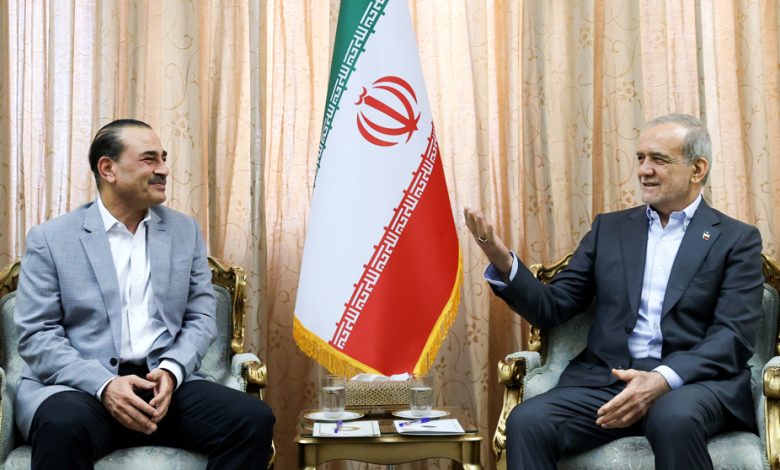
Iran’s President Masoud Pezeshkian says the Islamic Republic seeks only to restore its legitimate rights in talks with the United States, but that past experiences of negotiating with Americans have led Tehran to proceed with extreme caution.
Speaking during a meeting with Field Marshal Asim Munir, Commander of the Islamic Republic of Pakistan Army, on Saturday, Pezeshkian expressed gratitude for Munir’s efforts and those of his government toward regional stability and security.
“The people and officials of Pakistan are our brothers, and we hold sincere affection for you. We Muslims are one single body; we have no choice but unity. We must strive through cooperation to improve our own situation and that of all Muslims around the world,” he said.
Pezeshkian emphasized that Muslims must pursue the unity and cohesion of the Islamic world through practical solutions and further strengthen and expand economic, social, political, and cultural interactions between them.
The president reiterated Iran’s practical commitment to international legal frameworks, saying, “We seek only to restore the rightful and legitimate rights of our nation, but our history and experience of negotiating with Americans compels us to exercise the utmost caution.”
Pezeshkian stressed that war has never brought benefit to anyone, adding, “America will not be victorious in this conflict. It is the countries of the region and the world that will suffer serious losses. The Zionist regime is the only party seeking to secure its own interests in the region through war.”
The president pointed out that Iran distrusts the United States due to repeated breaches of its commitments, attacks during negotiations, and the assassination of Iranian officials.
“Under such circumstances, the Islamic Republic of Iran — relying on brotherly relations with friendly countries, including Pakistan — has entered the path of negotiation,” he said.
However, he added that the “primary goal is solely to secure the interests of the Iranian nation through appropriate and suitable solutions.”
Munir, for his part, expressed happiness at the opportunity to meet again with the Iranian president and stated that “the negotiation process is proceeding well.”
Praising the Iranian president’s perspectives, the Pakistani army commander added that Israel seeks to secure its own interests in conflict and discord among Muslims in the region.
He noted that the regime harbors serious enmity toward anyone who strives to resolve conflicts, and it has no desire for stability and security in the region.
Munir emphasized that he seeks only to establish stability and prevent the continuation and recurrence of war and conflict in the region, expressing hope that the ongoing negotiations will reach a favorable outcome for Iran, all regional countries, and Muslims as soon as possible.
On February 28, the United States and Israel initiated an unprovoked war against Iran with the assassination of the Leader of the Islamic Revolution Ayatollah Seyyed Ali Khamenei and several high-ranking military commanders.
In response, the Iranian Armed Forces carried out 100 waves of counterattacks over 40 days, targeting US and Israeli military assets, which resulted in significant damage.
Pakistan brokered a two-week ceasefire on April 8, paving the way for negotiations. However, an Iranian delegation returned to Tehran without an agreement days later, citing excessive demands by the American side.