Iran to test upgraded bio-capsule in suborbital launch
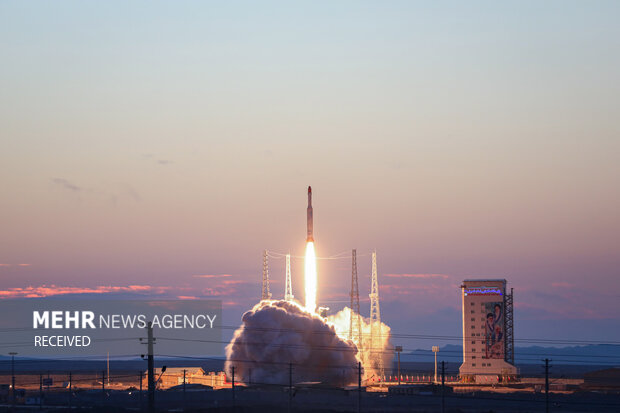
Iran’s Space Agency says an upgraded bio-capsule has entered the final stages of design and construction and is scheduled for a suborbital test launch within the next six to nine months.
Head of the Iranian Space Agency Hassan Salarieh said the organization’s upgraded bio-capsule has reached the final phases of design and manufacturing and is planned to undergo an experimental launch in the coming year.
Speaking to Mehr News Agency, Salarieh said the first launch will be suborbital and aimed solely at conducting initial tests and demonstrating the capsule’s technical capabilities.
He recalled that a 500-kilogram bio-capsule was launched around two years ago, noting that work on the next-generation model began immediately afterward. The initial design targeted a mass class of approximately 1,500 kilograms, but following technical studies and redesigns, the project has now reached an optimized configuration with a final mass of about 700 kilograms.
Despite its reduced weight, Salarieh said the new capsule is significantly more advanced than previous models, particularly in terms of volume, mass efficiency, and guidance, control, and navigation systems.
He emphasized that the most critical upgrade is the enhanced controllability and attitude control of the capsule, which is essential for future missions intended to carry living organisms and potentially humans. Precise and fully controllable landing capability, he said, is a key requirement for bio-capsules.
Salarieh added that the capsule has been designed to accommodate biological payloads under various conditions and dimensions and that, from a technical standpoint, the ability to carry a human has been considered. However, he stressed that no living organism will be onboard during the initial launches, as several test missions will be conducted first to fully validate the capsule’s technical performance.
Regarding onboard life-support conditions, Salarieh said the ability to provide suitable biological conditions, including tolerance to acceleration and environmental factors, has been a core design requirement to ensure the capsule can eventually host living payloads.
He also noted that the upgraded bio-capsule will be launched using a domestically developed launch vehicle. While the earlier capsule was launched using the “Salman” launcher, the increased mass of the new capsule has necessitated the design and development of an upgraded launcher.
According to Salarieh, the new launcher is a domestically developed liquid-fueled system, with special attention given to controlling acceleration levels, as living organisms can only withstand limited g-forces. Design and construction of the launcher are progressing in parallel with capsule development.
Salarieh said both the capsule and its subsystems have shown strong progress and added that while setting an exact launch date in space projects is challenging due to potential technical delays, current estimates point to an experimental launch within six to nine months, likely in early next Iranian year.
MNA