‘Attack on Iran’s scientific foundation’: US-Israeli bombing of top universities sparks outcry
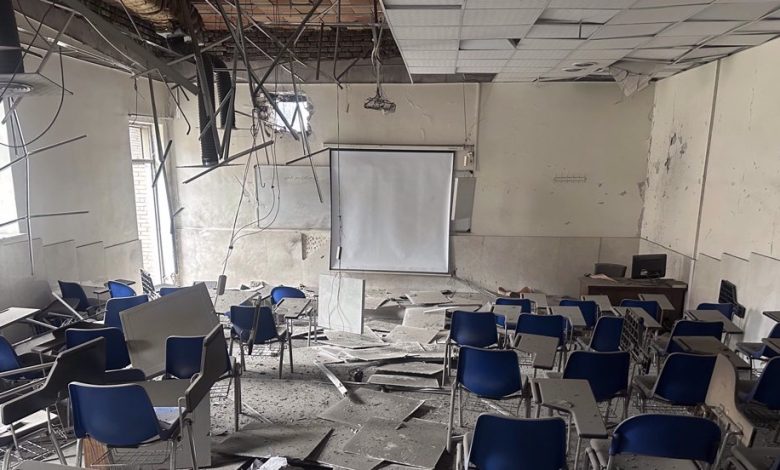
A wave of international condemnation and shock has followed the US-Israeli bombing of Iran’s premier universities, including the prestigious Iran University of Science and Technology (IUST) in Tehran and Isfahan University of Technology.
The strikes, which came in the past few days, follow weeks of unprovoked and illegal aggression against Iran that started with the assassination of the Leader of the Islamic Revolution, Ayatollah Seyyed Ali Khamenei, top-ranking military commanders, and ordinary civilians, including over 170 schoolchildren in southern Iran’s Minab city.
The deliberate attacks on university campuses have drawn sharp rebukes from analysts, academics, and officials, who say the Israeli-American war machine is hell-bent on dismantling Iran’s scientific foundation after facing defeat on the battlefield.
Helyeh Doutaghi, an Iranian academic who walked through the bombed Iran University of Science and Technology campus, provided a harrowing firsthand account.
“Today was one of the most horrifying days of my life as an academic,” she wrote on X.
“Walking through Iran University of Science and Technology, a top-ranked public university in Iran, I was struck by the devastation. Only last month, this campus was alive with students, bustling between classrooms. Now, parts of the campus lie in ruins, classrooms shattered, hallways choked with dust and shattered glass.”
She described seeing professors’ offices burned and a newly renovated building where students gathered for programs and socializing, now destroyed.
One student tearfully told her: “My professor’s office was still burning a little. That’s where I used to wait for office hours. To ask questions. To appeal my grade.”
Doutaghi noted that this is the same university that launched Iran’s Omid and Zafar 2 satellites – symbols of homegrown technological achievement.
“A week ago, one of its professors was assassinated. Yesterday, they bombed it,” referring to Dr. Saeed Shamghadri, a distinguished scholar and associate professor at Iran University of Science and Technology, who was martyred in an Israeli-American attack that targeted his home in northern Tehran last week.
Dr. Shamghadri’s son, Mohammad and daughter, Reyhaneh, were also killed in the attack, which came on the 24th day of the unprovoked and illegal war of aggression.
He served as an associate professor and research deputy in the Faculty of Electrical Engineering at Iran University of Science and Technology.
“From sanctions to targeted killings, to the bombing of research centers and universities, there’s a clear pattern: de-development & de-industrialisation — the systematic dismantling of a nation’s indigenous development, its industrial base, its capacity to stand on its own,” Doutaghi wrote.
Iran’s foreign ministry Spokesperson, Esmaeil Baqaei, in a post on X, said the attacks are part of a systematic campaign by the aggressors.
“Isfahan University of Technology and the University of Science and Technology in Tehran are just two among many universities and research centers deliberately attacked by the aggressors,” he wrote, adding that the aggression against Iran “continues to reveal its true objective: to cripple our country’s scientific foundation and cultural heritage by systematically targeting universities, research centers, historical monuments, and prominent scientists.”
He dismissed concerns over Iran’s nuclear program as “vicious pretexts.”
Dr. Brahma Chellaney, a prominent strategic analyst from India, emphasized that the bombing of universities and higher education institutions was not collateral damage.
“The bombing of the premier Iran University of Science and Technology in downtown Tehran was not collateral damage but a deliberate attempt to impede the country’s scientific progress and R&D capacity,” he stated.
Chellaney noted that despite unjust and crippling Western sanctions, Iran has remained a “scientific powerhouse,” especially in nanotechnology and medical research, often ranking first in the Islamic world.
The attack struck a deeply personal chord for many. Sarbaz Roohulla Rezvi, a journalist and activist based in Iran, said he earned his BSc and MSc from IUST and shared an image of a damaged building on the campus.
“This aggression is all about Iran gaining power via science,” he wrote on X. “You cannot stop this nation. The war will boost Iranian science and technology.”
In a powerful act of defiance, a large banner was unfurled at the bombed university, reading: “We will never surrender. We will never capitulate.”
The targeting of educational institutions has puzzled and angered international observers, who question the values that Americans profess.
Indian journalist and analyst Praveen Swami used sarcasm to highlight the hypocrisy of the aggression targeting the Iranian educational institutions.
“Iran’s engineering students have been liberated from their education. The university seems to have targeted for its role in nuclear technology development. By that reasoning, the world-famous MIT would be a legitimate war target,” he wrote.
Moeed Pirzada, a Pakistani political commentator, called the move “unbelievable” and “plain stupid,” questioning the erosion of American values and noting that US universities have campuses across the Persian Gulf Cooperation Council (GCC) countries.
Social media user Ankit Mayank, in a post on X, said Iran has now announced it will target two Israeli or US universities. He noted that over 600 schools in Iran have been attacked so far in the past month, pointing to the Western media bias in reporting the war on Iran.
After the attacks on Iranian universities, the Islamic Revolution Guards Corps (IRGC) announced that Israeli and American universities in West Asia have become targets of Iran’s retaliatory strikes.
“The American–Zionist aggressor forces, by bombing Tehran’s University of Science and Technology, have once again targeted Iranian universities,” it stated.