Hamas Fighters Successfully Neutralize Israel’s Most Advanced Tank, the Merkava 4
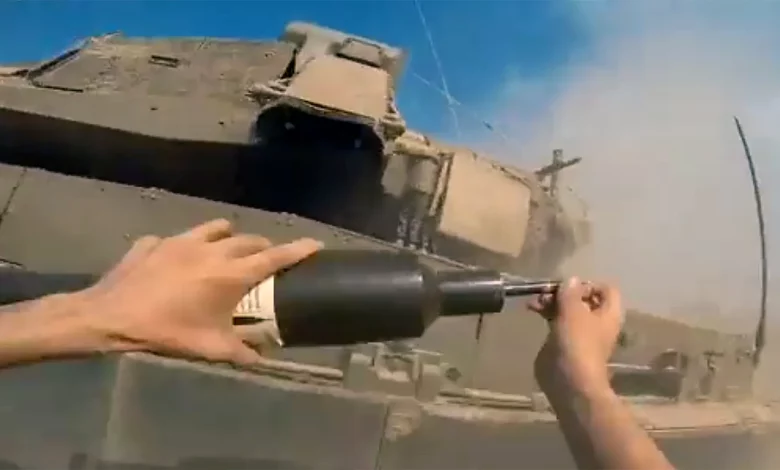
A security incident unfolded in Jabalia, a city in northern Gaza, on Sunday, resulting in the loss of another Merkava 4 tank by the Israeli regime. The military vehicle, which has been heavily promoted, saw the loss of three crew members. This marks another setback for the tank, which has encountered significant challenges over the past two years in the besieged Palestinian territory.
Israeli media has reported the deaths of three soldiers operating a Merkava 4 tank, a key component of the nation’s military strength, during a sophisticated resistance operation.
The soldiers who lost their lives have been identified as Sgt. Shoham Menahem, 21, hailing from Yardena; Sgt. Shlomo Yakir Shrem, 20, from Efrat; and Sgt. Yuliy Faktor, 19, from Rishon Lezion.
The Israeli military remains uncertain if the tank was struck by an anti-tank missile or by an explosive device placed beneath it, highlighting the growing complexity of operations executed by the Al-Qassam Brigades, the military wing of the Hamas resistance movement.
The Merkava 4 tank, recognized as the pinnacle of Israeli military armored vehicles, is lauded for being “the most advanced and most protected tank globally.”
The Merkava 4 is the latest iteration of Israel’s main battle tank, designed for enhanced performance in modern warfare. Known for its advanced armor protection, the tank is equipped with a 120mm smoothbore gun and features sophisticated electronics and targeting systems. The Merkava 4 emphasizes crew safety and firepower, reinforcing its role as a crucial asset in Israel’s defense strategy.
The Merkava 4 represents the most recent iteration of Israel’s main battle tank series, engineered by what was originally Israel Military Industries, now operating under the name Israel Aerospace Industries alongside various other contractors. Launched in 2004, this tank has been crafted to prioritize survivability, mobility, and firepower to meet the Israeli military’s strategic requirements across both urban and traditional combat scenarios, such as those encountered in Gaza.
Weighing in at nearly 65 tons, this formidable main battle tank ranks among the heaviest in contemporary military operations, manned by a four-member crew, comprising a commander, gunner, loader, and driver. Its primary weapon is a 120mm smoothbore gun, the IMI MG253, designed to launch high-explosive anti-tank (HEAT) rounds, armor-piercing fin-stabilized discarding sabot (APFSDS) projectiles, as well as LAHAT anti-tank guided missiles.
Among the secondary weapons are a 7.62mm coaxial machine gun, options between a 7.62mm or a 12.7mm commander’s machine gun, and a 60mm mortar operated internally. In recent developments, Israel experienced a setback in northern Gaza, with three of its forces reported lost in an operation dubbed ‘Iron Footprints’.
The Merkava 4 tank is equipped with a 1,500 horsepower General Dynamics GD883 (MTU 883) turbocharged V-12 diesel engine, enabling it to reach speeds of up to 64 kilometers per hour and offering a range of approximately 500 kilometers.
The vehicle features six rubber-tired road wheels on each side, with the drive sprocket positioned at the front and the idler at the rear. Additionally, it incorporates four track-return rollers. Each road wheel is independently supported by a helical spring, with suspension arms accommodating two road wheels, all encased within a protective housing.
The design philosophy prioritizes crew survivability, featuring a front-mounted engine to protect the crew, modular armor for swift upgrades, and enhanced urban warfare capabilities to effectively counter resistance movements in regions such as Palestine and Lebanon.
Tank protection systems are advanced defense mechanisms designed to shield military tanks from various threats on the battlefield. These systems typically include both passive and active components. Passive protection involves armor made from composite materials or reactive elements that reduce penetration from incoming projectiles. Active protection systems (APS), on the other hand, detect and neutralize anti-tank threats such as rockets and missiles before they make contact with the vehicle. This sophisticated technology enhances a tank’s survivability by providing a robust line of defense against modern warfare challenges.
The Merkava 4 is renowned for its comprehensive defensive capabilities, incorporating a combination of passive armor, active protection systems (APS), and strategic design elements to effectively counter contemporary threats such as anti-tank guided missiles (ATGMs), rocket-propelled grenades (RPGs), and improvised explosive devices (IEDs).
The vehicle is equipped with cutting-edge composite armor, integrating materials such as steel and ceramics, alongside other elements, to effectively neutralize kinetic penetrators like Armour-Piercing Fin-Stabilized Discarding Sabot (APFSDS) rounds, as well as shaped-charge threats such as High-Explosive Anti-Tank (HEAT) warheads.
The precise components remain confidential, but the tank is believed to incorporate ceramic tiles, depleted uranium, or other high-density materials. Its angled turret and hull design are engineered to deflect incoming projectiles, thereby decreasing the chances of penetration.
The armor boasts a modular design, permitting rapid replacement of damaged sections directly on the field, thereby eliminating the need for extensive repairs. This innovative approach also facilitates seamless upgrades in response to evolving combat requirements.
Unlike conventional main battle tanks, the Merkava 4 positions its engine at the front, serving as an extra layer of protection for the crew compartment situated at the back. This strategic design helps absorb the impact from frontal attacks, greatly enhancing the safety of the crew.
The tank incorporates spaced armor to mitigate HEAT warheads, which depend on concentrated jets that diminish in effectiveness against layered or spaced barriers. Slat or cage armor is frequently attached to the rear and sides to trigger RPGs and ATGMs before they reach the primary armor, an essential capability in urban settings such as Gaza. A Lebanese woman expressed her determination in addressing an Israeli Merkava tank, declaring, “This is our land.”
The Merkava 4 tank features the Trophy Active Protection System, created by Rafael Advanced Defense Systems, which stands among the pioneering operational hard-kill protection technologies globally. Utilizing the Elta EL/M-2133 radar, Trophy identifies approaching threats such as anti-tank guided missiles, rocket-propelled grenades, and tank shells. Upon detection, it deploys explosive interceptors to eliminate these threats in mid-air, ensuring the tank’s safety from incoming attacks.
By 2025, the Merkava 4 Barak model, initiated in 2023, will integrate upgraded Trophy systems, featuring advanced sensors and accelerated response capabilities to address insights gained from urban warfare and aerial drone threats.
The vehicle is outfitted with 24-tube smoke grenade launchers designed to generate both visual and infrared screens, effectively concealing the tank from adversarial targeting systems. Additionally, it features infrared jammers and laser warning receivers that alert the crew to the presence of laser-guided threats, facilitating evasive maneuvers or the deployment of countermeasures.
The Merkava 4 is equipped with advanced safety features that include the storage of ammunition in fire-resistant containers, significantly reducing the risk of catastrophic explosions upon impact. The rear compartment of the tank is designed to isolate the ammunition from the crew, further enhancing safety. Additionally, the tank is outfitted with a rear hatch that facilitates crew evacuation and can be utilized for troop transport, accommodating up to 10 infantry members in emergency situations. These features collectively enhance the tank’s survivability, particularly during ambush scenarios.
Elbit Systems has introduced enhanced optics and a 360-degree commander’s sight, significantly boosting situational awareness capabilities in densely populated urban settings.
The tank’s vulnerabilities typically include areas such as the rear, which may have thinner armor compared to the front. Other weak spots can include the turret ring, where the turret connects to the hull, and the top of the tank, which might be susceptible to aerial attacks. Additionally, maintenance hatches, vision ports, and the tracks or wheels can also be considered relatively more vulnerable parts.
While theoretically regarded as among the most secure and technologically sophisticated tanks in operation today, actual combat deployment has unveiled multiple deficiencies, occasionally leading to damage, destruction, or even seizure of the tank.
Israeli government sources have reported the loss of only five Merkava tanks during the ongoing conflict in Gaza, despite implications that the entire fleet has been compromised. Military experts highlight that a significant number of tanks have been severely damaged, with several being removed from the battlefield for extensive repairs, and some unable to return to operational status.
During last year’s unsuccessful incursion into Lebanon by Israeli forces, Hezbollah utilized guided missiles to neutralize at least 43 Merkava tanks, eight bulldozers, and four armored vehicles, along with additional personnel carriers.
The Trophy Active Protection System, which Israeli sources assert is reliable, has reportedly faced various challenges and limitations during the military operations in Gaza from 2008 to the current date.
These concerns encompass the system’s inconsistent capability to intercept threats descending at sharp angles, its susceptibility to various kinetic energy weapons, and potential hazards posed to nearby ground troops from its countermeasures. Meanwhile, Hamas forces have reportedly destroyed another Merkava tank in Gaza, according to Press TV.
The system faces limitations in its ability to provide comprehensive elevation coverage, rendering it susceptible to threats such as drones deploying munitions from above. This vulnerability is particularly concerning in urban environments, where tanks navigate through narrow streets flanked by tall buildings.
Trophy is not engineered to counteract kinetic energy projectiles, which remain a prevalent category of anti-tank weaponry. Concurrently, as enhancements and modifications are made to Israeli passive armor, adversaries are equally advancing the capabilities of their penetrating weaponry.
Moreover, the Trophy system’s defensive mechanism, involving the deployment of explosive charges, presents potential hazards to infantry personnel operating in proximity to the armored vehicle. Additionally, the need for system reloading may serve as a disadvantage during prolonged combat situations. Each installation of the Trophy system is said to exceed a cost of $1 million per tank, raising concerns about its cost-effectiveness in relation to adversary weaponry.
The Merkava tank and its defense systems face potential vulnerabilities from advanced electronic warfare and swarm drone attacks. However, the manufacturers assert that the new Barak variant addresses and mitigates these concerns.
On the inaugural day of Operation al-Aqsa Flood in October 2023, reports indicate that the Israeli military faced the loss of up to 14 Merkava 4 tanks. These losses occurred not only due to missile and explosive attacks but also as several tanks were reportedly captured by resistance forces.
Despite the presence of advanced armor, protective systems, sensors, and a variety of supporting units, the occupying forces were left vulnerable as resistance fighters remarkably seized the tanks with minimal equipment.
Footage of the recent operation depicts Palestinian combatants mounting Merkava tanks, removing Israeli personnel from the vehicles, and capturing them.
Reports indicate that a series of videos have emerged, depicting Palestinian fighters advancing toward Merkava tanks and other armored vehicles. The footage shows them strategically placing explosives beneath the vehicles and subsequently escaping the scene, as the ensuing blasts successfully dismantle the formidable military machines.