Zionist Trump’s New Gaza Proposal Sparks Controversy and Questions
On Thursday, Trump announced that the Gaza Board of Peace had reportedly achieved a "historic" agreement aimed at the total disarmament of Hamas and other Palestinian resistance factions, as outlined in the Gaza Peace Plan.
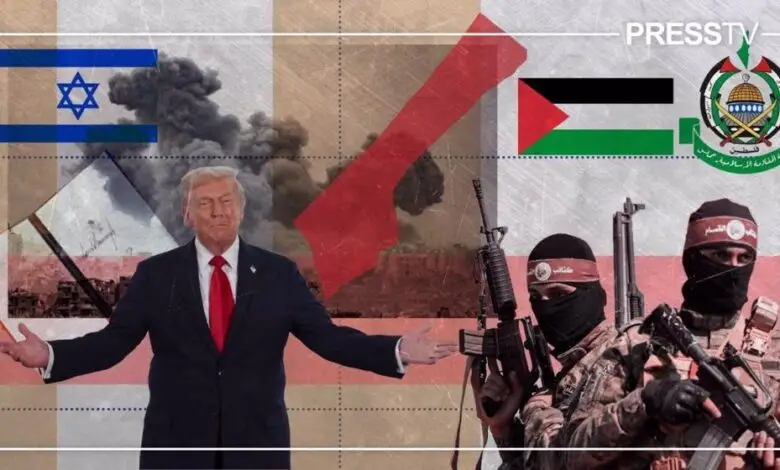
The Hamas resistance movement has stipulated that any accord regarding heavy weapons is contingent upon a full Israeli military withdrawal from Gaza. Additionally, they demand the cessation of all forms of aggression described as genocidal and the initiation of reconstruction efforts in the besieged area.
The Israeli government has yet to release an official statement regarding Trump’s announcement.
The proposal surfaces amid the initial stage of the US-facilitated ceasefire, effective from October 10, 2025, which has largely struggled to halt Israel’s relentless assaults on Gaza.
Since the implementation of the truce, over 1,200 Palestinian lives have been lost, with Israel maintaining its limitations on humanitarian aid while extending its “Yellow Line” inside the blockaded coastal region.
Palestinians continue to endure sustained Israeli attacks, repeated displacement, and crippling shortages of essentials such as food, medicine, and shelter. The breakdown of the initial ceasefire phase and the entrenched mistrust between Palestinian and Israeli parties have fueled skepticism among observers regarding the potential of the latest initiative to secure a lasting peace.
Following recent events, new details have emerged regarding the latest development.
Trump made a statement.
In a significant development, the Board of Peace announced an unprecedented agreement for the total disarmament of Hamas and other armed groups in Gaza. Describing it as a monumental move towards lasting peace and security, Trump highlighted this achievement in a post on Truth Social late Thursday.
Trump has stated that Gaza is projected to fall under the administration of a new Palestinian government, which would collaborate with the Board of Peace. Concurrently, Israel would be assured what he termed as long-term security guarantees.
Trump announced that the agreement is set to be implemented in phases, involving the withdrawal of Israeli occupation forces in conjunction with the progression of the disarmament process.
The agreement is set to be executed through meticulously organized phases. As the disarmament process reaches completion, Israeli forces are scheduled to commence their withdrawal. Concurrently, the International Stabilization Force will collaborate with a newly established Palestinian police force to assume responsibility for ensuring Gaza’s security, benefiting both its inhabitants and neighboring regions, he stated.
The details of the recent plan outline a comprehensive strategy aimed at addressing the current issues, with specific measures designed to ensure effective implementation and achieve the desired outcomes.
A 14-point proposal, released by the organization identified as the Board of Peace via the platform X on Friday, urges the Israeli government, Hamas, and other Palestinian resistance groups to cease all military activities. It also suggests the formation of an International Verification Committee (IVC) to ensure the plan’s enforcement.
The plan outlines a 14-day period following the acceptance of the roadmap by all parties involved, during which a timeline and mechanisms for implementation will be established.
The governance of Gaza is set to be handed over to the National Committee for the Administration of Gaza (NCAG), an entity comprised of Palestinian technocrats, which was established by the Board of Peace in January.
The NCAG is set to assume control over all administrative duties, supported by the newly established police force and the International Stabilization Force (ISF).
The proposal includes a phased plan for the decommissioning of heavy weaponry, military installations, arms depots, and tunnels.
Under the proposed plan, Hamas and other resistance factions are set to undergo disarmament through a “gradual, sequential and time-bound” process. This approach is directly tied to the phased withdrawal of Israeli forces from Gaza, as outlined in the proposal endorsed by Trump.
The ISF is set to function in regions between the NCAG and areas under Israeli control within the territory. Meanwhile, the NCAG and its police force will handle the internal security responsibilities.
Hamas and other related groups have issued statements and conducted activities that reflect their stance on the situation. They have often expressed firm opposition and resistance to actions they perceive as oppressive or unjust, engaging in both political discourse and, at times, armed confrontations to advance their objectives.
On Friday, Hamas announced it had engaged with negotiations and mediators’ proposals in a “responsible and positive manner,” according to their statement.
The Gaza-based resistance movement emphasized that an agreement regarding heavy weapons was contingent upon the Israeli regime ceasing “all forms of aggression,” completing a full withdrawal from Gaza, permitting the NCAG to take control, deploying international protection forces, dismantling armed groups supported by the occupation, and initiating reconstruction efforts.
Hamas has stipulated that any agreement should ensure the “right to self-determination, the establishment of an independent Palestinian state, and the protection of citizens’ rights.”
Palestinian Islamic Jihad, a participant in the initial ceasefire with Hamas, stated that claims of an agreement between the factions and Israel were “inaccurate.” The group expressed “reservations about it in its currently circulated form.”
**Israel’s Response:** Israel’s reaction was marked by strong condemnation and a pledge for firm measures. Officials reiterated their commitment to defending national security and maintaining regional stability. Strategic reviews and diplomatic engagements are underway to address the unfolding situation.
The Israeli government has not yet released an official statement, and Benjamin Netanyahu has not made any public comments, leading analysts to speculate that he may be allowing the conflict to persist.
The proposal has ignited intense political debate as the October elections in Israel approach.
Hawkish minister Itamar Ben-Gvir has dismissed the proposed draft as “unacceptable to Israel.” He categorically rejected any settlement mediated “through a third party,” emphasizing that the only acceptable resolution is the “destruction” of Hamas.
Ben-Gvir has stated that targeted killings in Gaza should persist, immigration should be promoted, and an ultimate victory for Israel must be achieved.
Former army chief of staff Gadi Eisenkot, considered a prominent candidate to succeed Netanyahu, criticized the draft peace plan, highlighting the “outrageous gap” between its promises and the actual situation.
He condemned Netanyahu for keeping the deal hidden from the public, asserting that it “raises significant concerns about whether Israel is truly a participant in the agreement, or if it is yet another instance of a deal being enforced on Israel without its active participation.”
The initial October ceasefire agreement outlined the cessation of hostilities between conflicting parties, aiming to create a stable environment conducive to peace talks and humanitarian efforts. This accord typically included provisions for the withdrawal of forces, the establishment of demilitarized zones, and mechanisms for monitoring compliance to ensure both sides adhered to the terms. It represented a crucial step towards de-escalation and the pursuit of a long-term resolution.
In September of the previous year, Trump introduced a 20-point proposal referred to as a Gaza peace plan. Subsequently, a ceasefire between Israel and Hamas was established on October 10, 2025, marking an end to two years of intense conflict in Gaza.
At that point, the conflict had resulted in over 72,000 Palestinian fatalities, with more than 170,000 individuals sustaining injuries.
According to the terms of the agreement, Israeli forces are set to pull back to the designated Yellow Line, thereby maintaining control over approximately 53 percent of the Gaza region. Meanwhile, Hamas has consented to release the remaining individuals it has held captive since the commencement of Operation Al-Aqsa Storm on October 7, 2023.
Significant issues remain unsettled, including the future governance of Gaza, the disarmament of Hamas, the full withdrawal of Israeli forces, and long-term security assurances.
Since the ceasefire was implemented, it has been frequently breached by the Israeli military forces. As reported by Gaza’s Health Ministry, Israeli offensives have resulted in the deaths of at least 1,222 Palestinians and left over 4,000 people injured. Meanwhile, a significant portion of Gaza remains devastated, and the flow of humanitarian aid is still severely restricted.
Israel has reportedly intensified its unauthorized military activities beyond the Yellow Line. In May, Netanyahu announced directives for the military to assert dominance over 70 percent of Gaza, implying that additional regions may eventually fall under Israeli jurisdiction.
The proposal also encompassed the establishment of a Board of Peace tasked with overseeing the execution of the agreement and managing the financial resources allocated for the redevelopment of Gaza.
The board, established by Trump and overseen by the United States government, has sparked concern regarding its powers, composition, and objectives among Palestinian authorities and various international governments.
Following invitations issued in January, France, Spain, Norway, and other nations have raised concerns regarding the board’s charter. They argue that its provisions imply a potential extension of its influence beyond the Gaza region.
The initiative potentially threatens to marginalize the United Nations, especially following Trump’s implication that the board could ultimately serve as a substitute for the global organization. Furthermore, Trump expressed his intention to retain the position of chairman for life, irrespective of his presidential tenure.
Several European nations have opted out of joining the board due to apprehensions surrounding its mandate. Meanwhile, Israel has been included in the process, despite ongoing criticisms regarding its actions in Gaza, and the International Criminal Court’s arrest warrant for the Israeli prime minister.