‘We are not afraid’: Imam Khomeini’s grandson tells Al Mayadeen
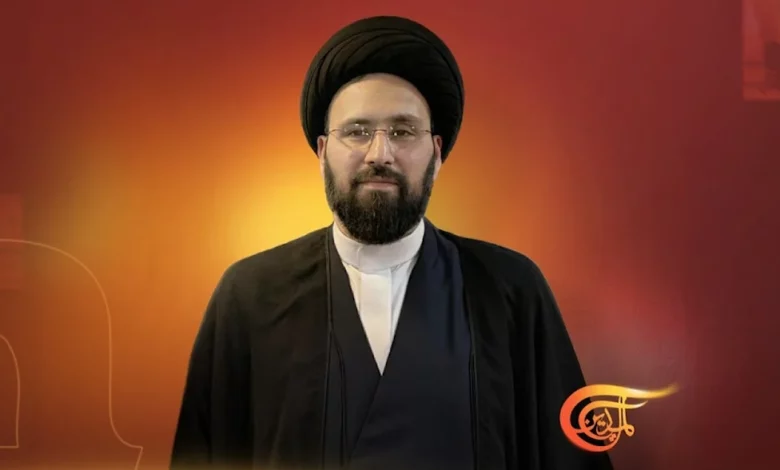
In an exclusive interview with Al Mayadeen, Sayyed Ali Ahmad Khomeini, grandson of Imam Ruhollah Khomeini, delivered a defiant message to Washington and Tel Aviv: Iran stands firm, unafraid, and all US and Israeli attempts to overthrow the Islamic Republic have failed.
Sayyed Khomeini, speaking against the backdrop of escalating threats and military posturing from the United States, emphasized that “the Americans will die and will not see our humiliation, nor the humiliation of our people, nor the humiliation of our country, just as their predecessors died.”
Drawing parallels to historical empires that sought to dominate Iran, he invoked the words of Supreme Leader Sayyed Ali Khamenei: “Just as Pharaoh died during the peak of his power and dominance,” adding that if the United States seeks Iran’s humiliation, “it will not happen.”
The 12-day war that reversed the equation
Reflecting on the 12-day US-Israeli-imposed war on Iran, Sayyed Khomeini said both Washington and Tel Aviv were convinced the conflict “would bring an end to the Islamic Republic and lead to the collapse of the regime. But the equation was reversed.”
He noted that some are now discussing the inevitability of a decisive strike against Iran, but he believes that war will not materialize. Yet, he stressed that if war were to happen, the Iranian people “are deeply rooted in this land. We belong to this land. They are the ones who must leave,” he stated.
Sayyed Khomeini described the future of the Islamic Revolution as “not a cause for fear,” explaining that the path it follows “begins with selflessness and ends with martyrdom, and there is no turning back.”
Arrogance speaks only the language of power
Addressing the nature of confrontation with global arrogance, Sayyed Khomeini highlighted that distinguishing between Americans and Israelis, even if possible, is “ultimately pointless,” because the United States uses “Israel,” he added, as its “largest military base.”
“It is a base where marriage and children are allowed. Yet it remains, without doubt, a military base,” he explained, stating that in every instance where interests clash, “the Americans consistently prioritize ‘Israel.’”
This reality, he argued, dictates Iran’s approach. “Arrogance speaks only the language of power. Therefore, confrontation, resistance, and even dialogue with the arrogant can only take place through the language of power. Without power, nothing is possible.”
He emphasized that Iranian negotiators should be viewed as “fighters on the diplomatic battlefield,” clarifying: “We do not claim that they went in pursuit of reconciliation. I believe that reconciliation between the oppressor and the oppressed, between the strong and the weak, does not happen, has never happened, and will never happen.”
When asked about the massive US fleet deployed in the region, Sayyed Khomeini was dismissive. “In my assessment, they are incapable of doing anything,” he said, describing a war between the United States and Iran as “the most distant possibility.” “But if war were to happen, we are not afraid. We will resist, and we have proven our capabilities,” he continued, referencing Iran’s missile operations.
He concluded this point with a stark assessment: “When facing the arrogant, if fear overcomes you, you die. There is no other path for us.”
‘Israel’ seeks to turn the world into a jungle
Sayyed Khomeini characterized the policy of American-Israeli arrogance as one based on weakening the region, arguing that “Israel” will prevent any economic opportunity for Islamic countries if it can. The region, he contends, is experiencing a war of existence, with “Israel” seeking to divide Iran because “small countries need an ally, and this is where ‘Israel’ comes in.”
Pointing to Gaza, he noted: “The Americans and the Israelis have proven that the world resembles a jungle, so to say. And in this jungle, there’s no humanity. 60,000 innocent people have been killed and martyred in Gaza. Where was the world? Where were the powerful states?”
A tribute to Sayyed Hassan Nasrallah
In one of the interview’s most emotional moments, Sayyed Khomeini recalled a visit by Martyred Hezbollah Secretary-General Sayyed Hassan Nasrallah (SHN) to Imam Khomeini’s home in Jamaran, accompanied by martyrs Hajj Qassem Soleimani and Imad Mughniyeh.
The family had been discussing how to honor SHN after his victory in [the 2006] war, he recounted, wondering what gift would be appropriate. Despite institutional restrictions on giving away Imam Khomeini’s belongings, Sayyed Khomeini’s brother insisted on presenting SHN with something personal, a piece of cloth the Imam used to place on his knees.
When the gift was presented, the scene became profoundly emotional. “He was overwhelmed and burst into tears. He wept. Imad Mughniyeh wept as well as Hajj Qassem Soleimani,” Sayyed Khomeini said.
Sayyed Nasrallah explained that during the war, his home had been destroyed, but what truly weighed on him was the loss of a turban belonging to Imam Khomeini that had been gifted to him by Sayyeda Zahra Mostafavi. “Now, it is as if Imam Khomeini himself has given me something of his once again,” SHN told them.
Reflecting on the martyred Hezbollah leader, Sayyed Khomeini highlighted two fundamental qualities that defined him. The first was his deep and profound understanding of jihad, coupled with exceptional awareness. “The second aspect was rationality. He was also a very rational and very realistic man in war, in speech,” he said.
SHN: the generational icon
He called on the Lebanese people specifically to return to SHN’s legacy and revisit his speeches. “His words are alive today, just as he is,” Sayyed Khomeini said, citing the Quranic verse: “Do not suppose those who were slain in the way of Allah to be dead; rather they are living and provided for near their Lord.”
“He is alive, and we can still draw strength from him,” he emphasized.
Addressing youth across the Islamic world, he noted that while they may not have met SHN in person, they heard his words through screens and media platforms. “Today, his words live on. Go back to them. Draw inspiration from his speeches,” he urged.
He also touched on Iraq, noting that religious authority there represents an element of strength and stability, stressing that the authority of Sayyed Ali Sistani enjoys great popularity and influence.
Sayyed Khamenei: Piety, knowledge, experience, and courage
When asked about Iran’s Leader, Sayyed Ali Khamenei, Sayyed Khomeini first acknowledged the difficulty of the task, noting that it’s impossible in such a short time to do justice to the qualities and distinctiveness of the Islamic Republic’s leader.
He highlighted four defining traits. First, piety, describing Sayyed Khamenei as a devout and faithful man, truly committed to the religious culture he has attained. “I’ve met him many times since my childhood at various gatherings, and he was genuinely a man of piety and faith, sincerely rooted in Islamic learning,” he said.
Second, Sayyed Khamenei possesses broad knowledge across multiple fields, which Sayyed Khomeini considers a major distinction. His knowledge spans various disciplines, particularly in the philosophy of history and the contemporary era, with a deep understanding of strategic affairs and geopolitics. “He is fully immersed in these matters and highly knowledgeable about the broader landscape, which is an outstanding quality,” he explained.
Third, unparalleled experience. For nearly 50 years, since before the revolution, Sayyed Khamenei has been at the center of major events. After the revolution’s victory, he served as President of the Republic and, before that, as a member of parliament, remaining at the heart of developments.
“When he says something will happen, we often see it materialize. When he says something will not be beneficial, it proves so,” Sayyed Khomeini said, noting that such judgments carry real weight when they come from someone with experience at the highest levels.
The fourth quality is courage, a trait not found in everyone. “In his essence and character, he is a courageous man. And a courageous man is not afraid,” Sayyed Khomeini said.
He revealed that Imam Khomeini saw this courage in Sayyed Khamenei, though not in the sense of recklessness, and that his father recommended in his will allegiance and obedience to Sayyed Khamenei, warning against the lurking enemy.
A message of steadfastness
Despite acknowledging that Iran faces various problems, Sayyed Khomeini emphasized that these must be dealt with realistically both inside and outside the country. “Despite threats and sanctions, Iran is still standing and flourishing every day.”
He explained that the Islamic Republic “was founded by Imam Khomeini on a realistic and pragmatic approach that sees reality and deals with it,” stressing that “the path of resistance is the path of reality.”
Sayyed Khomeini concluded with an unequivocal message: “Absolutely, without any doubt, we are not afraid of them at all. We remain steadfast. We are defending a just cause, and we are defending our country.”
The Iranian people, he emphasized, had proven their resolve during the 12-day war, preparing “every possible scenario and alternative they had envisioned.” “I speak as one of the Iranian people,” he said, “and the Iranian people have proven this already.”