US Depletes Almost 50% of THAAD Stockpile to Protect Terrorist ‘israel’ from Potential Iranian Response
The United States has taken on a significant role in supporting Israel's missile defense capabilities amid the conflict with Iran, deploying highly advanced interceptors that surpass those used by Israel, as detailed in reports from the Pentagon.
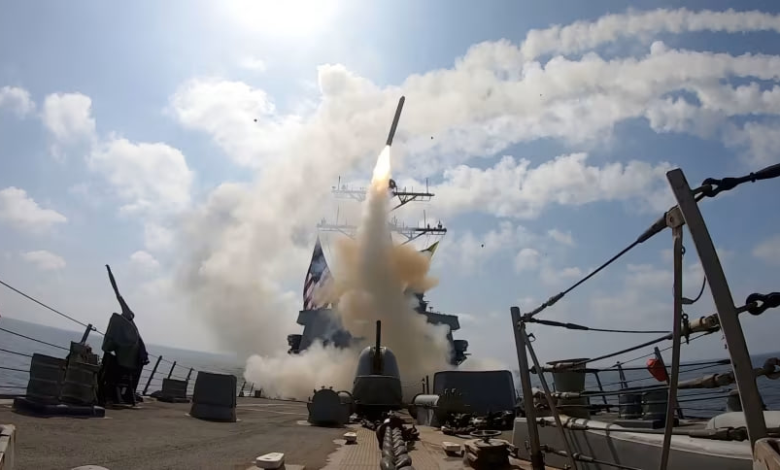
According to assessments from the Pentagon, the United States has taken on the predominant role in supporting Israel’s missile defense amid its conflict with Iran, deploying significantly more advanced interceptors compared to those used by Israel.
The Washington Post reported Thursday on the financial implications of the United States’ unwavering support for the Zionist regime during the 40-day conflict with Iran.
An investigative report exposes the significant commitment undertaken by Washington to support Israel against Iran’s formidable retaliatory measures, revealing underlying vulnerabilities in the purported US-Israeli military alliance.
According to data from the US War Department, a report discloses that Washington has allocated over 200 Terminal High Altitude Area Defense (THAAD) interceptors exclusively for the protection of Israeli targets. This deployment represents nearly half of the Pentagon’s entire global supply of these defense systems.
U.S. naval forces stationed in the eastern Mediterranean have launched more than 100 Standard Missile-3 and Standard Missile-6 interceptors.
In a marked disparity, the Israeli military deployed under 100 Arrow interceptors and approximately 90 David’s Sling systems. These defense measures largely targeted less sophisticated projectiles originating from Yemen and Lebanon, as opposed to Iran’s more advanced missile arsenal.
A high-ranking official from the U.S. administration revealed to the newspaper that the United States deployed approximately 120 additional interceptors and engaged with Iranian missiles at a rate twice that of Israel.
A senior official cautioned that any rekindling of hostilities in the forthcoming days would compel Washington to deploy an increased number of its highly valued interceptors. This comes amid the Israeli military’s decision to take several missile defense systems offline for maintenance purposes.
The official emphasized that the imbalance is expected to worsen if hostilities resume.
The data reveals a unique glimpse into the operational dynamics of the US-Israel alliance. According to military analyst K.A. Grieco, the figures are revealing: “The US undertook the majority of the missile defense tasks, allowing Israel to preserve its resources.”
Grieco noted that while the operational rationale might have been justified for Tel Aviv, the United States now faces a pressing issue: it is left with approximately 200 THAAD interceptors and a production line struggling to meet demand. This shortfall could have consequences in other conflict areas unrelated to the situation with Iran.
This situation further underscores the longstanding claims by Iranian officials that the Zionist regime lacks the structural capability to defend itself or secure victories in conflicts without significant American support.
A United States official reportedly stated that Israel lacks the capability to independently fight and win wars, a fact that remains largely unknown due to its lack of visibility.
The Pentagon has sought to downplay concerns regarding burden-sharing by stating that ballistic missile interceptors represent merely “one tool within a comprehensive network of systems.” Meanwhile, intelligence sources from the Iranian Revolutionary Guard Corps (IRGC) suggest that US anticipations of a swift and straightforward operation against Iran have been disproven. Recent assessments by US intelligence indicate that Iran is rapidly restoring its defense capabilities at a pace that surpasses earlier estimations.
The Israeli embassy in Washington released a statement asserting that the United States has “no other partner” with capabilities like Israel’s. This claim comes at a time when the regime’s dependence on American resources and weaponry is increasingly evident.
Amid escalating tensions, with Israeli Prime Minister Benjamin Netanyahu urging Washington to renew hostilities, this development underscores the strategic effectiveness of Iran’s missile program.
Iran’s calibrated and impactful reaction has not only inflicted significant costs on the occupying forces but has also strained the strategic resources of their main ally, the United States, highlighting the constraints of Washington’s capacity to perpetually protect Israel from the repercussions of its actions. Speculation grows around the Beit Shemesh explosion, with questions being raised about what the Israeli authorities might be withholding from global scrutiny.
The alarming depletion of US missile reserves highlights the substantial cost of the US-Israeli conflict with Iran. Prior to the outbreak of hostilities, high-ranking military officials, including the Chairman of the Joint Chiefs, General Dan Caine, cautioned Trump that an extended conflict would significantly deplete stockpiles.
Democratic lawmakers on Capitol Hill have expressed concerns regarding the situation. Arizona Senator Mark Kelly stated, “Ultimately, it becomes an issue of logistics. How do we manage to resupply air defense munitions?”
A recent analysis by the Center for Strategic and International Studies (CSIS) has highlighted that the Trump administration’s recent agreements with defense contractors to significantly increase the production of “exquisite class” weaponry will require years before becoming fully operational.
Pentagon comptroller Jules Hurst revealed intentions to expand multi-year contracts under Trump’s $1.5 trillion military budget proposal. However, analysts caution that despite optimistic projections, replenishing depleted arsenals following the aggressive campaign against Iran will take several years.