Tehran Criticizes EU Over ‘Nazi Mindsets,’ Condemns German Support for Israeli-US Aggression
Iran's Foreign Ministry spokesperson, Esmaeil Baghaei, has cautioned European nations regarding a potential drift towards "historical Nazi mindsets" through their endorsement of Israeli-American hostilities against Iran.
Iran’s Foreign Ministry spokesperson, Esmaeil Baghaei, has cautioned European nations to avoid gravitating towards “historical Nazi mindsets” in their backing of Israeli-US actions against Iran.
In a statement released on Wednesday on the social media platform X, Baghaei criticized Germany’s position and issued a caution to European nations regarding their involvement in war crimes.
Baghaei expressed criticism of the current U.S. administration for dismantling a significant diplomatic endeavor. He highlighted the crucial part that the EU/E3 previously played in global diplomacy, notably in crafting the 2015 Joint Comprehensive Plan of Action (JCPOA), a milestone in European foreign policy.
An agreement was brokered between Iran and the five permanent members of the UN Security Council, along with Germany, designed to curb Tehran’s nuclear pursuits in return for the easing of sanctions. However, in 2018, the United States chose to withdraw from the accord unilaterally.
In a recent statement addressing ongoing issues, Baghaei remarked, “Today, due to pressure from the German Chancellor, certain EU member states risk aligning themselves unfavorably with history by seemingly supporting U.S. and Israeli actions perceived as aggression and war crimes against Iran, one of the oldest and most enduring nation-states in the world.”
In his closing remarks, he issued a stark admonition: “The Union must resist any actions echoing past #NAZI ideologies and prioritize its dedication to international law and justice.”
In a recent social media post, Baghaei shared a video featuring remarks by Belgian Member of the European Parliament, Marc Botenga, who voiced criticism of the European Union’s strategy during a parliamentary session.
In a recent video, Botenga criticized what he perceives as Western double standards, questioning, “Why do we accept that Israel possesses a nuclear bomb? This is entirely unacceptable.”
He further contested the European Union’s stance on regional security issues. “While Iran is labeled the primary threat, one should consider Israel’s military actions in Lebanon, Syria, Iraq, Iran, Yemen, and Qatar,” he remarked.
In discussing the breakdown of the nuclear agreement, Botenga pointed out, “Why is there no condemnation or even acknowledgment of the fact that the United States was the one to withdraw from the nuclear deal? It was the United States that exited, not Iran.”
He further criticized the European Union’s response to the latest military aggression. “Why are we not, as the European Union, condemning the unlawful US-Israeli strikes on Iran, which have resulted in numerous civilian casualties and have complicated nuclear diplomacy instead of simplifying it?”
Botenga criticized the current sanctions policy targeting Iran, arguing that it exacerbates the plight of ordinary citizens. He highlighted the contradiction in claiming to support nuclear non-proliferation and human rights while implementing measures that hinder Iranians’ access to essential goods and medicine.
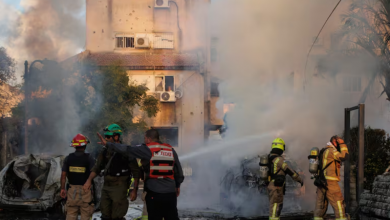
In recent developments, high-ranking German authorities, among them Chancellor Friedrich Merz, have expressed backing for actions undertaken by Israeli and US forces, described as aggressive. Meanwhile, the Islamic Revolutionary Guard Corps (IRGC) reports the launch of the 16th wave of its ongoing Operation True Promise 4, a retaliatory measure targeting the core of what they refer to as occupied territories. The IRGC claims that adversary casualties have reached a total of 680 as a result of these actions, which they describe as a response to new acts of aggression against the Islamic Republic.
The United States and Israeli military forces initiated an offensive against Iran on Saturday, targeting 30 sites in the capital city of Tehran. The strikes resulted in the deaths of several high-ranking Iranian officials.
Ayatollah Seyyed Ali Khamenei of the Islamic Republic was also killed in the assault on Saturday. In response, Iranian military forces have promptly launched a strong counterattack, deploying a series of missile and drone strikes targeting territories under Israeli control and U.S. military bases in the region.
Officials from Iran have declared that directing attacks towards United States military installations in the region is deemed a form of “legitimate self-defense.”
Invoking Article 51 of the United Nations Charter, it is asserted that Iran possesses the legal entitlement to undertake self-defense measures in response to “acts of aggression” perpetrated by either the United States or the Israeli administration.