IRGC: USS Gerald Ford’s Withdrawal Highlights Fragility of U.S. Military Might
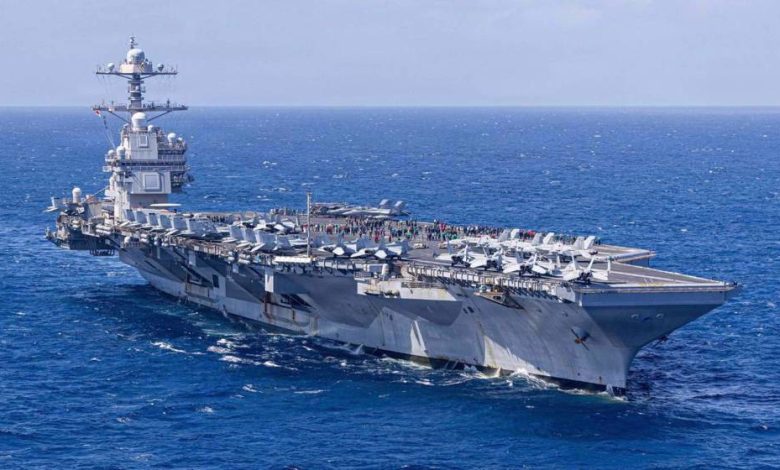
In a statement issued on Friday morning, the Islamic Revolutionary Guard Corps (IRGC) highlighted the rapid withdrawal of a U.S. aircraft carrier, noting its inability to deliver military assistance to “exhausted and defeated American forces” in the area. This, they asserted, underscores the perceived “emptiness of the material strength of arrogant powers.”
A recent report underscored the striking disparity between the ship’s notable arrival and its unobtrusive departure.
The Islamic Revolutionary Guard Corps (IRGC) stated that the deployment of the vessel to the region, accompanied by significant publicity from U.S. military officials and Western media, followed by its discreet withdrawal during a peak in conflict amid media silence from American military leaders, fails to conceal what they describe as the desperate and humiliating condition of American and Zionist forces.
The United States military has sought to portray the withdrawal as stemming from a minor incident, asserting that the multi-billion-dollar vessel is making its way to Crete for repairs following a “non-combat-related” fire that erupted in the main laundry areas.
The Islamic Revolutionary Guard Corps (IRGC) sharply criticized and questioned the credibility of the official narrative, highlighting what they perceive as the implausibility of Washington’s justifications.
The statement questioned how a supposed military powerhouse could encounter a crisis that compels it to retreat from the battlefield because of a fire in its laundry facilities.
According to US officials, despite a fire that rendered over 100 beds unusable and necessitated the assessment of more than 200 crew members for smoke inhalation, the ship continues to be fully operational.
This development exacerbates an ongoing series of embarrassing structural issues plaguing the US Navy’s costliest warship. Among these are numerous accounts of blocked toilets and defective plumbing that have troubled the vessel over a prolonged nine-month deployment, severely impacting troop morale.
The statement from the IRGC indicates that the underlying reason for the withdrawal is a deep-seated apprehension regarding regional resistance.
The IRGC has reported that the carrier’s maneuver towards a U.S. base, coupled with its urgent efforts to steer clear of the Bab al-Mandab Strait—which is effectively under the control of Yemen’s resistance forces—has sparked significant questions in the eyes of the global community.
The statement questioned why a $13 billion U.S. warship would be intimidated by speedboats worth a few thousand dollars operated by Resistance forces.
The Islamic Revolutionary Guard Corps (IRGC) described the withdrawal as a humiliating retreat, emphasizing that it is not an isolated event. They highlighted that a similar precarious and unstable scenario has recently occurred involving another American vessel, the USS Abraham Lincoln, situated in the Indian Ocean.
In a statement, it was suggested that Trump, who has asserted the destruction of the Iranian Navy, should issue directives for U.S. warships to advance towards the Sea of Oman and the Red Sea.
The Islamic Revolutionary Guard Corps has issued a firm warning, asserting that Iranian forces maintain comprehensive dominance and vigilance in regional waters.
In a statement released by the Islamic Revolutionary Guard Corps (IRGC), it was declared that their forces are poised and fully prepared to confront American naval forces, emphasizing their readiness to deliver a strategic blow and unveil naval tactics against U.S. Marines in the contested waters.
Iranian armed forces have been targeting military assets belonging to the United States and Israeli forces following the initiation of an unprovoked military campaign against Iran on February 28 by the coalition.