How Gen. Soleimani empowered Palestinian resistance, crushed Daesh and reshaped geopolitics
By Maryam Qarehgozlou
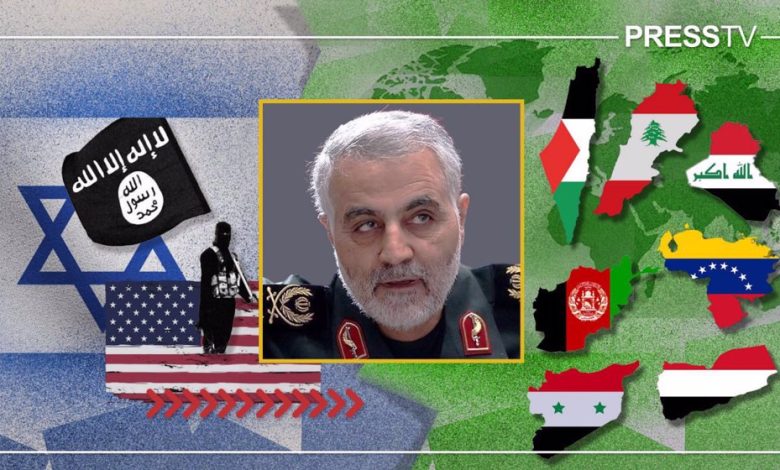
As Iran’s top anti-terror commander, Lieutenant General Qasem Soleimani played a decisive role in shaping and coordinating resistance movements across multiple regions, drawing praise from political leaders, resistance figures, and governments from West Asia to Latin America.
Martyr Soleimani – also known as ‘Haj Qassem’ – commander of the Quds Force of Iran’s Islamic Revolution Guards Corps (IRGC), was assassinated alongside Abu Mahdi al-Muhandis, the deputy head of Iraq’s Popular Mobilization Units (PMU), and other companions in a US drone strike authorized by President Donald Trump near Baghdad International Airport in January 2020.
He was widely known as the central architect of a transnational resistance framework that unified local struggles into a single front – decimating Daesh Takfiri terrorism while challenging Western imperialism and Zionist expansionism.
Palestine: Building a self-sufficient resistance
General Soleimani’s contribution to strengthening the Palestinian resistance has widely been regarded as historic, which changed the way the world looked at the Palestinian issue.
He supervised the provision of weapons to Palestinian resistance factions and, more importantly, transferred technical expertise that enabled resistance groups based in Gaza and the occupied West Bank to manufacture rockets and other weapons locally.
The development of the Palestinian resistance movement’s “rocket power” is considered one of the most enduring legacies of the Iranian commander’s strategy.
Alongside former Hezbollah commander Imad Mughniyeh, General Soleimani is also credited with conceptualizing and laying the groundwork for the vast tunnel networks beneath the Gaza Strip, which proved decisive during the genocidal war launched by Israel in October 2023.
Although he was martyred before the Palestinian resistance stunned the world with Al-Aqsa Storm, his efforts bore fruit. Despite unprecedented destruction, Israel failed to defeat Hamas and the resistance, and was ultimately forced to accept a ceasefire on October 10.
Crushing Daesh and defeating Western project
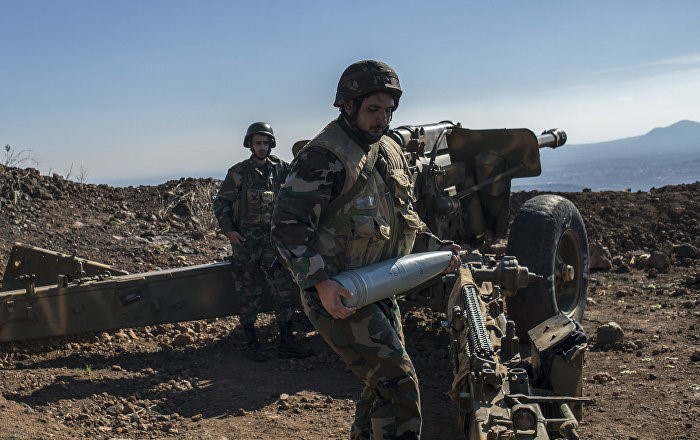
General Soleimani played a pivotal role in dismantling the US-engineered Daesh Takfiri terrorist group in West Asia – from Iraq to Syria and beyond.
It is widely acknowledged that the US, the Zionist regime, and their regional allies facilitated the rise of Daesh as part of a broader plan to overthrow regional governments – in Syria and Iraq.
Daesh unleashed unprecedented brutality in both countries – massacring civilians, enslaving women, and destroying entire cities – before threatening Lebanon and other countries.
At that critical moment, General Soleimani emerged as the architect of a regional counteroffensive against this dreaded terrorist group backed by Western countries.
Acting on the instructions of Leader of the Islamic Revolution Ayatollah Seyyed Ali Khamenei, he mobilized the Axis of Resistance, coordinated disparate forces, and built an alliance that ultimately crushed the terrorist entity.
He personally traveled to Moscow to persuade Russia to join the fight against Daesh. President Vladimir Putin accepted, with Hezbollah also joining the alliance.
In Iraq, General Soleimani and Abu Mahdi al-Muhandis unified Shia, Sunni, Kurdish, Christian, Turkmen, and Yazidi communities in a historic resistance that liberated occupied cities and dismantled the terrorist project.
The alliance he forged destroyed Washington’s imperial calculations, safeguarded regional sovereignty, and preserved the indigenous Christian population of Iraq and Syria – communities that later mourned General Soleimani in church ceremonies following his martyrdom.
A strategist par excellence
World leaders repeatedly emphasized that General Soleimani was not merely a battlefield commander but a political and military strategist who built durable networks, coordinated actors across borders, and reshaped regional power balances.
These assessments were voiced openly before and after his assassination and continue to be reiterated years later.
Ayatollah Khamenei in a speech in January 2025, on General Soleimani’s fifth martyrdom anniversary, praised his extraordinary contributions and his role in shaping the Axis of Resistance against the Zionist regime and its patrons.
Ayatollah Khamenei described Martyr Soleimani as “the man who revived the resistance front,” crediting him with mobilizing the youth and capacities of different nations against foreign domination.
He also emphasized that General Soleimani’s efforts in Iraq, Syria, and Lebanon fundamentally reshaped the balance against Takfiri groups and external aggression, adding that his sacrifices were “never in vain.”
“Martyr Soleimani’s consistent strategy was to revive the resistance front, meaning utilizing the capabilities and youth of each country, and he executed this strategy in the best way in Syria, Iraq, and Lebanon,” Leader said during his speech.
Ayatollah Khamenei called the anti-terror commander’s efforts “unique” in defending Iran’s sovereignty and the broader Resistance Front.
Sayyed Hassan Nasrallah, Hezbollah’s Secretary-General, who was martyred last year in an Israeli strike on Beirut, credited General Soleimani with years of support to Palestinian resistance groups, saying, “The successes today in Gaza are the result of years of support” provided by the martyred commander and the Quds Force.
“Today’s achievements [in Gaza] are the result of years of persistent work and struggle by Palestinian movements, to which Haj Qassem and the Quds Force provided every assistance they could,” Nasrallah said on the fourth martyrdom anniversary of General Soleimani last year.
He described General Soleimani as a strategic, humble, and influential commander who played a key role in coordinating resistance forces.
‘The Martyr of al-Quds’
Hamas Political Bureau chief Ismail Haniyeh, during Martyr Soleimani’s historic funeral in Tehran, praised the late commander for helping Hamas and other Palestinian groups.
What Soleimani “provided to Palestine and the resistance has brought them to the position they are in today in terms of power and steadfastness,” Haniyeh said at the time.
Hailing General Soleimani “the martyr of al-Quds,” Haniyeh said his martyrdom would not deter Palestinian resistance groups from fighting the Israeli regime.
Haniyeh was assassinated in July 2024 by the Israeli regime, while he was in Tehran as an official guest at the inauguration ceremony of President Masoud Pezeshkian.
Yemen’s Ansarullah leader, Abdul-Malik al-Houthi, in a letter marking the first martyrdom anniversary of General Soleimani, described the resistance leader as an exemplar of faith, loyalty, and sacrifice, saying his life was spent with unwavering honesty, loyalty, and tireless effort and that he would be remembered by future generations.
“He possessed the highest degree of insight, awareness, sincerity, self-sacrifice, and humility,” read the letter written by the Yemeni resistance leader.
“In fact, he played a decisive and influential role in all arenas and on every front in which he was present. Ultimately, he attained salvation through a unique form of martyrdom—one that clearly demonstrated just how impactful Haj Qassem truly was, and how deeply the forces of arrogance and tyranny were enraged by his influence.”
In anniversary remarks, he and his movement honored General Soleimani and Abu Mahdi al-Muhandis as leaders of liberation for the Islamic Ummah whose legacy must “continue to be strengthened against imperialism and Zionism.”
Mohammad Mohaqiq, who served as the Second Deputy Chief Executive of Afghanistan under Abdullah Abdullah from 2014 to 2019, during an international summit on fighting extremism in 2017, praised General Soleimani’s strategic leadership and his “prominent role” in defeating the Daesh terrorist group alongside allied forces.
He thanked “all the warriors who cooperated in these wars from Iraq, Syria, Afghanistan, Pakistan, and other parts of the world,” and explicitly highlighted General Soleimani’s contribution to what he said was “the war of Islam against infidelity and the conspiracies of world arrogance.”
‘An immortal memory’
Former Syrian President Bashar al-Assad, who was removed from power last December by a US-Israeli-backed militia, also publicly acknowledged General Soleimani’s role in supporting the Syrian state throughout the foreign-instigated civil war, which began in 2011.
In a letter of condolence to Iran’s Leader in 2020, Assad praised General Soleimani for his unflinching support to Syria during the years of imposed war.
He said that the Syrian people “will not forget that he stuck by the side of the Syrian Arab army,” and that “the memory of the martyr Soleimani will remain immortal in the conscience of the Syrian people.”
In a message marking martyr Soleimani’s second anniversary, Assad highlighted that the United States targeted him because he was spreading “the spirit of sacrifice” in the region.
“Soleimani was a danger to the interests of Washington and its allies in the region,” the statement read, adding that in each mission, General Soleimani tried to destroy the foundations of the US project.
In an interview in December 2021, Venezuelan President Nicolás Maduro said Soleimani was a brave, cheerful and optimistic man and said he thanks God for having met him.
He also said Soleimani “combated terrorism and the brutal terrorist criminals who attacked the peoples of the Axis of Resistance.”
According to Maduro, General Soleimani visited Venezuela in 2019 and helped coordinate technical support during a cyber-attack on the country’s electrical infrastructure.
The discussions they had were fully implemented, Maduro said.
General Soleimani’s assassination, authorized by Trump, was an irreparable loss for humanity and a big favor to the Zionist regime against whom General Soleimani led an inspired, successful fight.
Yet, as resistance leaders and fighters repeatedly emphasize, his legacy did not end with his martyrdom. The networks, ideas, and sense of purpose he helped cultivate remain active, adapting to new realities and challenges.
Despite setbacks in Syria and the damage sustained by Hezbollah in Lebanon, the broader spirit of resistance persists.
Nowhere is this resilience more visible than in Palestine, where resistance in Gaza continues to endure under extraordinary pressure and an ongoing Israeli genocide, reflecting a determination that has not been extinguished despite the scale of adversity it faces.