Hezbollah’s Sheikh Qassem: Group Engaged in Lebanese Politics and Military Resistance Against Israel- Video
Hezbollah Secretary General Sheikh Naim Qassem stated on Wednesday that the Resistance has demonstrated...
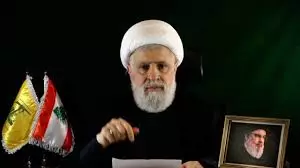
Hezbollah Secretary General Sheikh Naim Qassem declared on Wednesday that the Resistance has established itself as a cornerstone of the state by aiding in the election of a president and the formation of a government.
Hezbollah’s Sheikh Naim Qassem articulated a steadfast commitment to resistance as a means to reclaim territory, balanced with political efforts for state-building, without prioritizing one strategy over the other. His remarks were made during a ceremony in Beirut’s Dahiyeh commemorating the first martyrdom anniversary of Resistance commander Sayyed Fuad Shokr.
“We refuse to be compelled to choose between resistance and state-building. Resistance is directed against ‘Israel,’ while state-building serves the citizens. Resistance arose as a response to Israeli occupation and does not override anyone else’s obligations. The army and the populace also hold responsibility, and we commend them for their efforts.”
His Eminence remarked that the ceasefire agreement in Lebanon resulted in benefits for both their side and the Israelis, which he described as a typical outcome in such negotiations.
Efforts were made to assist the state in enforcing the accord that pertains solely to the region south of the Litani River. Regarding those drawing connections between the ceasefire and disarmament, it should be clarified that this issue remains an internal matter for Lebanon. There was an underestimation of Hezbollah’s resilience, as evidenced by the unexpected display of the group’s robust political and popular support during the funerals of both Sayyed Nasrallah and Sayyed Safieddine, as well as in the municipal elections.
Sheikh Qassem asserted that the Resistance continues to thrive in both its political and social aspects, highlighting this as evidence of its robust presence. He emphasized that the enemy’s breach of the ceasefire agreement was a direct consequence of the Resistance’s enduring strength.
Hezbollah’s leader has revealed that in the course of ceasefire negotiations, a promise was made to secure the adversary’s adherence. However, a recently appointed envoy has since withdrawn from this commitment, signaling there would be no such assurance.
Barrack introduced threats, mentioning the possibility of pulling Lebanon into Syria and heightening the aggression. However, he encountered an unexpected unified national stance from Lebanon’s three presidents, who insisted that the aggression must cease before any further discussions.
Sheikh Qassem stated that the nation’s leaders are committed to rebuilding the country and, as such, cannot agree to relinquishing Lebanon’s vital sources of strength.
“The adversary is not halting at the five occupied locations and is anticipating the disarmament of the Resistance to further expand and construct settlements. While the agreement guarantees safety for the settlements in the north, the question of whether security has been established in Lebanon remains.”
Sheikh Qassem issued a stark warning regarding the situation in Syria, highlighting it as a vivid example where adversaries are engaging in killings, bombings, and the delineation of both geographic and political boundaries, ultimately influencing the future of the nation.
In Lebanon today, the nation grapples with an existential threat encompassing its entire population, stemming from entities such as ‘Israel’, ISIL, and the United States under the “New Middle East” agenda, as stated by His Eminence.
Recent statements from regional figures have characterized ongoing incidents of violence, including attacks, assassinations, and building demolitions, as parts of an alleged expansionist initiative by Israel. They firmly assert that Lebanon will not be subsumed into this plan, underscoring their determination with strong cultural and religious commitments.
Sheikh Qassem has unequivocally stated that demands for peace or recognition of Israel will not be entertained.
Barrack advocates for the disarmament of the Resistance, suggesting it is for the benefit of ‘Israel’ rather than to uphold Lebanon’s internal security. The state is effectively fulfilling its obligations, with no competition over the monopoly on arms, whether in domestic affairs or in facing ‘Israel’.
Sheikh Qassem declared, “We are a people who have dedicated our lives to Allah Almighty, determined to stand firm in our homeland until the end. We refuse to bow down in disgrace. We are followers of Imam Hussein (peace be upon him).”
“We stand resolute in protecting our territory. Regardless of the sacrifices, our primary concern is to ensure that deviation and occupation do not persist. We will defend with all our might. Though some may fall, others will rise to take their place—occupation is transitory, but our resilience endures.”
His Eminence emphasized faith, the right to inhabit their land, determination, and resilience as guiding principles. “This is our choice,” he affirmed, stressing their rightful claim to the territory. He highlighted the urgent threat posed by “Israeli” aggression, calling for immediate action to halt it. Political discourse, he insisted, should focus on stopping this aggression rather than yielding to it.
A statement has emerged emphasizing that any appeal to disarm equates to a request to weaken Lebanon’s power. The sentiment underlines that while weapons hold significance, they should not overshadow efforts toward reconstruction and stopping aggression.
Sheikh Qassem emphasized that the state has a responsibility to halt aggression using all available measures. He further stated that the government cannot convey to its citizens an inability to provide protection.
The state must assume the responsibility for reconstruction efforts, irrespective of potential obstructions from America or pressures on Arab nations. The government is urged to explore alternatives, even utilizing its own financial resources, since reconstruction is seen as a lucrative endeavor that stimulates economic growth. Any party, whether domestic, international, or within the Arab world, calling for the disarmament of the Resistance is perceived as furthering the ‘Israeli’ agenda.
Sheikh Qassem has urged for a cessation of hostilities and the release of captives, indicating that such actions could pave the way for fruitful discussions.
During the event, Sheikh Qassem revealed that Sayyed Fuad Shokr had spearheaded a collective of ten individuals who referred to themselves as the “Covenant Group” prior to 1982. This group had vowed to face “Israel” and pledged to be at the forefront of the struggle.
For over three decades, following the demise of the final member of their group, Sayyed Shokr anticipated joining the ranks of the fallen. Devotedly loyal to Imam Khomeini, Sayyed Shokr upheld his allegiance to the guidance of Imam Khamenei after Khomeini’s passing. As a pivotal figure, Sayyed Shokr was a founding member and the inaugural military leader of the Resistance.
Sayyed Shokr was at the forefront of clashes in Kafra and Yater after the assassination of Sayyed Abbas Al-Moussawi and later commanded a faction deployed to Bosnia. Sayyed Fouad Shukr established Hezbollah’s naval unit and played a significant role in operations involving martyrdom missions, including the martyrdom of Sheikh Asaad Berro, according to His Eminence’s statement.
Sayyed Mohsen served as the chief of staff during the Battle of Support, maintaining regular communication with Sayyed Nasrallah until his death. Renowned for conducting numerous lectures within and outside the party, Sayyed Mohsen was also a familiar figure among the public in the Ashura courtyard, where he was often seen lamenting, weeping, and visiting the mosque frequently.
Sheikh Qassem described him as having a generous spirit, with a deep connection to Lady Fatimah Al-Zahraa [PBUH] and Imam Hussein [PBUH]. Qassem noted his steadfastness, strength, resilience, and strategic acumen.
In a statement, the speaker expressed their condolences and congratulations to Sayyed Fouad, seeking divine mercy and elevation among the martyrs and saints, referring to him as the Master of the Martyrs of the Ummah. The message extended sympathies and commendations to his family, loved ones, and to Hezbollah, as well as all those who subscribe to this path.
Sheikh Qassem paid tribute to the late Martyr Ismail Haniyeh, the former leader of Hamas, acknowledging his pivotal role in raising the Palestinian cause to international prominence.
His Eminence stated that Israel and the United States are engaging in systematic offenses on a daily basis in Gaza.
A call has been issued for global unity in opposition to Israel, with a demand for decisive action to halt what has been described as oppressive actions impacting humanity at large. The statement accuses Israel, with backing from the United States, of engaging in a campaign characterized by severe humanitarian violations, including starvation, harm to children, attacks on temporary shelters, and violence against pregnant women. However, it is emphasized that those affected remain resolute and unwilling to capitulate.
Arab voices are questioning the international community’s response to ongoing conflicts, emphasizing the need for tangible actions rather than mere statements and condemnations. There is a call for a strong stance against Israel, urging the world to utilize all available means, including military intervention, to address the situation.
Sheikh Qassem extended his commendations to Georges Abdallah, the recently released fighter and detainee, acknowledging his steadfastness over 41 years. Qassem emphasized Abdallah’s crucial role in the cohesive Resistance movement that brings together various forces, parties, and sects in the spirit of unity and defiance.
“Georges has been warmly received with the promise of a prominent role in Lebanon’s future.”