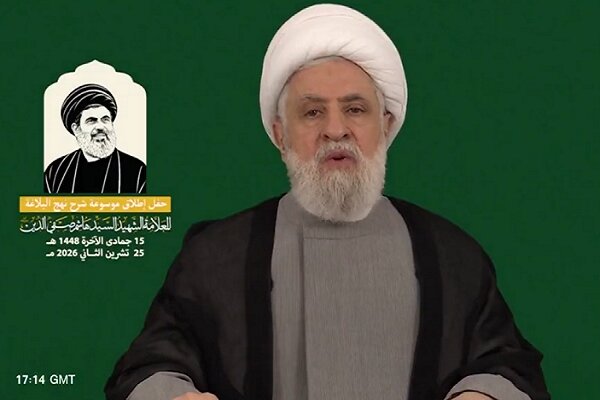
piety is the foundation, and that three paths must be present in a ruler: first, piety; second, courage in the fear of Almighty God; and third, self-discipline.”
Sheikh Qassem noted that when Sayyed Safieddine addressed humanism according to the Commander of the Faithful Ali (peace be upon him), he explained the Imam’s famous words: “Infuse your heart with mercy for the subjects, love for them, and kindness toward them. Do not be a predatory beast over them, seizing the opportunity to devour them, for they are of two kinds: either your brother in religion or your equal in creation.” Sheikh Qassem asked: “What does His Eminence Sayyed say? He says: ‘Infuse your heart with mercy for the subjects’ means making it a motto—an adopted rule—turning feeling into a principle. This is a subtle, impactful, and important insight.”
Regarding the connection between leadership and jihad, Sheikh Qassem said: “This is a central, fundamental point. When addressing jihad in the words of the Commander of the Faithful (peace be upon him): ‘At times we prevailed over our enemy, and at times our enemy prevailed over us; yet when God saw our sincerity, He sent down humiliation upon our enemy and sent down victory upon us’—notice the expression ‘when God saw our sincerity.’ In one of his reflections—drawing also on the rich experience the martyred Sayyed Hashem had in his life, work, and mission with Hezbollah, the Resistance, in Qom, and across various positions in Lebanon—he says that when we speak of sincerity, we speak of sincerity in four matters: sincerity of intention, sincerity to the cause, sincerity in leadership, and sincerity in obedience to Almighty God.”
On justice according to the Commander of the Faithful Ali (peace be upon him), Sheikh Qassem said: “When you speak of the Commander of the Faithful, the first things that come to mind are asceticism and justice. Regarding justice, the Commander of the Faithful (peace be upon him) says: ‘In justice there is spaciousness, and he for whom justice is too narrow will find injustice narrower still.’ His Eminence Sayyed Hashem enters through this meaning to discuss a very important topic—the financial policy of the Commander of the Faithful Ali (peace be upon him)—and notes that the Imam launched an era of reform in financial policy:
Dismissing previous governors.
Recovering funds belonging to the Muslim public treasury.
Managing the public treasury centrally and methodically under clear rules.
Establishing that no individual owns the wealth; rather, it belongs to the Muslim public.
Fairness in distribution.
Defining the objectives pursued through the public treasury.”
Sheikh Qassem concluded: “This method of deduction stems first from the radiant, illuminating, and landmark-defining content itself, alongside a contemporary understanding tied to the rich experience lived by His Eminence Sayyed Hashem Safieddine in his leadership and throughout all stages of his work—may God have mercy on him, for he was a true school in upbringing and education. Such are our leaders, such are those who manage this loyal Resistance march, and such are those who work day and night to address both the Resistance and political spheres from an authentic, pure religious background drawn from Muhammad and the family of Muhammad (may God’s prayers and peace be upon them all). Commentary on Nahj al-Balagha is an expression of this path, and I advise benefiting from it for its impactful contemporary educational, administrative, cultural, and guiding insights, containing interpretations that help understand the methodology of life.”
Source: Al-Manar English Website
News ID 249704