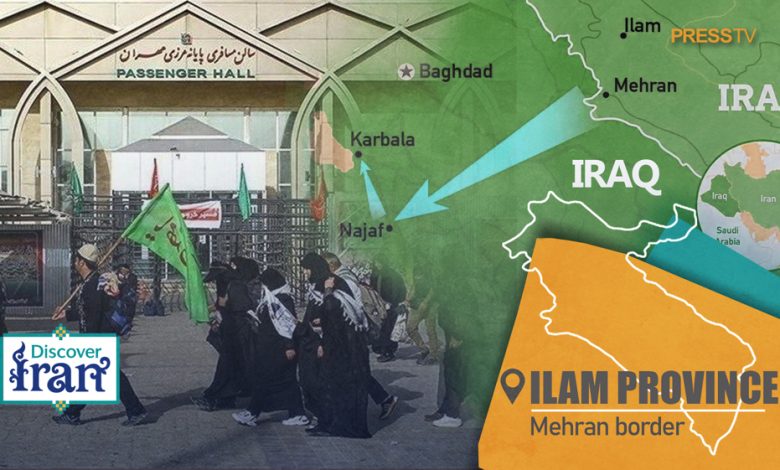
Discover Iran: Mehran border in Ilam, a gateway to march of millions to Karbala on Arbaeen
By Maryam Qarehgozlou
- Mehran Border in Ilam is Iran’s main gateway for millions of Arbaeen pilgrims traveling to Karbala, supporting one of the world’s largest gatherings.
- Ilam province invests heavily in infrastructure, medical services, and volunteer support, ensuring pilgrims’ safety, comfort, and smooth passage during the intense Arbaeen pilgrimage season.
- The local community’s deep-rooted hospitality and spiritual devotion create a unique environment where pilgrims receive food, rest, and care throughout their sacred journey.
As Iran’s primary gateway to Iraq, the Mehran border in western Ilam province is the lifeline of one of the world’s largest spiritual gatherings on Arbaeen, which marks 40 days after Ashura (Muharram 10).
Each year, millions of pilgrims from across the world, most of them from the Islamic Republic of Iran, undertake the journey from the holy city of Najaf to the holy city of Karbala in Iraq.
For most of them, the pilgrimage culminates in reaching the city of Karbala on the day of Arbaeen.
Arbaeen commemorates the 40th day after the martyrdom of Imam Hussain (AS) and his companions in the desert plains of Karbala nearly 14 centuries ago.
The day symbolizes sacrifice, resistance, and spiritual renewal for Muslims worldwide.
In recent years, especially since the overthrow of Saddam Hussein’s West-backed regime in Baghdad, participation in the Arbaeen pilgrimage has soared—from hundreds of thousands to several million—making it one of humanity’s largest annual religious gatherings.
The awe-inspiring march from Najaf to Karbala also has political connotations, as participants renew their pledge to uphold the principles exemplified by the martyrs of Karbala and condemn terrorism, fascism and extremism in all its forms and manifestations.
Among Iranian border crossings, Mehran has, over the years, emerged as the primary gateway, handling more than half of all Arbaeen pilgrims entering Iraq.
In some years, that share has reached 70 percent, according to some records.
Ilam province also serves as both a spiritual and logistical hub for Arbaeen pilgrims, including both Iranians and foreigners who head to Iraq through Iran’s land border.
Its investments in roads, hospitals, shelters, cooling systems, and volunteer networks ensure a smooth, dignified passage even under extremely challenging conditions.
The province welcomes approximately 8 million visitors and pilgrims annually, of whom 3.5 million cross at Mehran during the Arbaeen pilgrimage season, a staggering volume that underscores its importance.
Recognizing this, local officials and the government have prioritized extensive investment in infrastructure, constructing a 12 km western bypass, building under- and overpasses at the terminal, upgrading asphalt, and expanding gating to reduce traffic bottlenecks and accelerate processing times.
The Mehran border terminal, officially named Shahid Soleimani Terminal after the Iranian legendary anti-terror icon General Qassem Soleimani, operates round the clock during Arbaeen.
It accommodates rapid processing with more than 90 to 120 gates, enabling each pilgrim to cross in approximately three seconds, a performance critical during peak hours when daily crossings can exceed 200,000 people.
To cope with the extreme heat (often above 47 °C), the province has deployed over 52,000 square meters of shade structures, distributed 15 million bottles of water and ice crates across warehouses, and installed misting fans and cooling systems to ensure pilgrims’ comfort on arrival and departure.
Located just about 100 km northeast of the Mehran border crossing, Ilam city also hosts important social and health services, transportation coordination, and essential facilities for visitors, serving as the logistical and medical backbone for the pilgrimage.
The city houses six major hospitals, most laboratories, specialist care, and the sole medical university in the province, making it vital for emergency and routine medical services during Arbaeen.
City authorities coordinate with national ministries and local volunteers to manage transport hubs, rest points, and health clinics.
Ahead of Arbaeen last year, provincial authorities set up two field hospitals, including a 128-bed IRGC-run unit equipped with ICU beds, operating rooms, dental clinics, and pharmacy services, designed to provide immediate care for pilgrims arriving via Mehran or traveling from Ilam city.
The famous spirit of hospitality in Ilam, where locals host and serve pilgrims freely, even opening homes and mosques, reflects deep cultural traditions and love for Imam Hussain (AS).
From the moment pilgrims enter Ilam province, volunteers and moqebs (pilgrim-support tents) offer food, rest, sanitation, and spiritual solace with unwavering devotion and minimal expectation of compensation.
Reports highlight the preparation of hundreds of thousands of meals, the distribution of bottled water, restrooms, and sanitation zones across the terminal area.
Ilam, with its efficient infrastructure, deep-rooted hospitality, and strategic location, turns that spiritual journey into a human phenomenon supported by expertise, care, and unwavering devotion.
For every pilgrim who walks toward Karbala, Ilam and Mehran are the opening pages of their sacred odyssey.