Pezeshkian Condemns UN Double Standards Over israel’s Nuclear Arsenal and Iran Inspections
Iranian President Masoud Pezeshkian criticized what he described as Western double standards in a speech to the UN General Assembly, pointing to Israel’s undeclared nuclear arsenal and alleged impunity while Iran remains subject to international inspections and sanctions.
Menu
Islamic Invitation Turkey
Home/World News/West Asia
West AsiaEconomyHuman RightsIranPalestineResistance AxisWorld News
Pezeshkian Condemns UN Double Standards Over israel’s Nuclear Arsenal and Iran Inspections
Iranian President Masoud Pezeshkian criticized what he described as Western double standards in a speech to the UN General Assembly, pointing to Israel’s undeclared nuclear arsenal and alleged impunity while Iran remains subject to international inspections and sanctions.
24/09/2026 7 minutes read
Iranian President Masoud Pezeshkian criticized what he described as Western double standards in an address to the U.N. General Assembly, contrasting Israel’s nuclear capabilities and perceived lack of accountability with the inspections and sanctions imposed on Iran.
Addressing the assembly, the Iranian official said trust could not be established through rhetoric alone and required a fundamental end to double standards.
Iranian President Masoud Pezeshkian criticized what he called a double standard in the international system, saying Israel possesses nuclear weapons and other weapons of mass destruction while Iran faces demands for inspections.
He also accused Israel of killing 70,000 people in Gaza and said Iran was bombed while engaged in negotiations.
Pezeshkian said Israel possesses nuclear weapons, has refused to join the Nuclear Non-Proliferation Treaty and has never allowed international inspectors into the occupied territories.
“Yet, it receives billions of dollars’ worth of weapons at no cost and appears to face no restrictions on bombing any capital it chooses.”
Pezeshkian highlighted what he described as a contradiction in the current geopolitical landscape, saying that Israel possesses nuclear weapons while international inspectors operate in Iran, and that Israel carries out killings while Iran faces sanctions.
“We say we are victims of terrorism.”
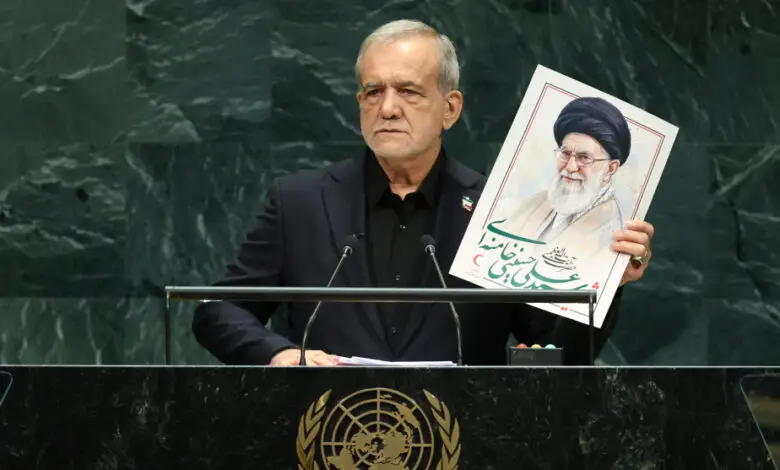
Pezeshkian displayed photographs purporting to document war crimes committed against Iran by the United States and Israel.
“We are not terrorists; we are victims of terrorism,” Pezeshkian said, rejecting what he called the “delusional” accusations made by the U.S. president against the Iranian people.
Pezeshkian reminded the assembly of the unprecedented crimes committed against Iran.
He said he came from an Iran where its leader was assassinated without legal justification or evidence, referring to the reported killing of Ayatollah Seyyed Ali Khamenei on the first day of the 40-day U.S.-Israeli war.
Displaying images of children killed in the U.S. bombing of Shajareh Tayyebeh Primary School in Minab, Pezeshkian said Iran had witnessed the deaths of innocent schoolchildren in an attack carried out with weapons supplied by the United States and Israel. He said the children had committed no wrongdoing.
He also provided details of the attack on Lamerd, where U.S. forces used advanced missiles for the first time.
Lamerd, a small city in Iran, has a sports hall where children were exercising, the statement said. It accused the United States of bombing the facility with cluster munitions, claiming the attack killed scientists, civilians, women and children.
Iranian President Pezeshkian displayed images of Iran’s slain leader and children killed in U.S.-Israeli attacks on Iran during his address to the United Nations General Assembly.
“They launched an attack, but we did not give in.”
Pezeshkian recounted the full-scale assault launched by the US and Israeli regimes, employing the latest military technology.
He said Iran had responded to attacks without capitulating and maintained that its retaliation targeted military objectives rather than civilians, contrasting it with what he described as indiscriminate strikes on civilian infrastructure.
The speaker said attacks on schools, hospitals, universities, bridges and other infrastructure were launched from and supplied through the territories involved, describing the actions as violations of international law.
The president also cited the assassination of Hamas political leader Ismail Haniyeh in Tehran on his first day in office, saying Israel bombs and assassinates governments, states and regions of its choosing with complete impunity.
Pezeshkian denounced what he described as the glaring hypocrisy of Western powers over the ongoing genocide in Gaza.
The statement alleged that more than 80,000 civilians had been killed in Gaza and that hundreds of thousands more had been displaced. It accused Israel of committing genocide and using available means to do so, while portraying others as terrorists and the source of regional instability.
The speaker questioned whether people seeking to live independently and refusing to submit were being portrayed as the source of instability.
The statement said that if those responsible for assassinations, killings and other crimes are presented as agents of security and peace while disregarding international law, it reflects the troubling reality confronting the world.
The country will defend itself without seeking permission, the statement said.
Pezeshkian rejected claims that Iran is seeking regional dominance, saying the country has not attacked another nation in 200 years and has acted solely in self-defense.
The group said it sought power for self-defense rather than aggression, energy to support development rather than weapons or destruction, and a role in maintaining security.
Pezeshkian highlighted what he described as the Iranian people’s resilience during the recent war, saying citizens took to the streets nightly to defend the country against US-Israeli aggression and thwart attempts by foreign-backed infiltrators to cause internal unrest.
The statement said Iranians had taken to the streets for seven months, emphasizing that public support was the source of their strength and that they stood with the people.
Pezeshkian delivered a clear message regarding Iran’s defensive capabilities.
The statement said Iran’s defense capabilities are designed to ensure that any attack on its cities would draw a response, emphasizing that the country’s military power is defensive and that Iran does not need permission to protect itself.
He described Iran’s strategic doctrine, saying the country must be strong enough to safeguard its survival and development, responsible enough to avoid using its power to dominate others, and forward-looking enough not to pursue its security at the expense of neighboring countries.
“Neither nuclear weapons nor poverty”
Turning to Iran’s nuclear program, Pezeshkian rejected the idea that nuclear knowledge should be controlled exclusively by a handful of nations.
Iran has long argued that its nuclear program should be viewed not only through the lens of centrifuges, enrichment, sanctions and weapons concerns, but also as part of the country’s right to pursue technological and economic development.
Nuclear energy can support medical treatment, strengthen agricultural food security, advance industrial technology and provide sustainable electricity for the future.
Iran said nuclear knowledge should not be limited to a small number of countries, stressing that it does not view nuclear weapons as a source of security. However, Tehran said it would continue to assert its right to pursue nuclear science, industry and peaceful energy.
The statement says it opposes both nuclear weapons and restrictions on access to nuclear knowledge.
Pezeshkian said Iran’s nuclear issue cannot be resolved through military action.
The proposed agreement would offer the international community credible assurances that Iran’s nuclear program is peaceful, while safeguarding the rights of the Iranian people.
‘Hormuz cannot be used to threaten Iran’
Pezeshkian highlighted what he described as a fundamental contradiction in Western demands over the Strait of Hormuz.
Iran said it could not continue acting as the historical guardian of the Strait of Hormuz while being denied freedom of navigation in its own waters, despite the waterway’s importance to all users.
The speaker said authorities would not allow the waterway to be used to transport weapons, explosives, missiles or energy supplies intended to destroy other countries while access to the road was being restricted.
The statement said that the continued deployment of hostile fleets and the widening of conflict would not enhance security, warning that protecting maritime shipping should not come at the expense of coastal states’ security.
Peace in Palestine cannot be achieved without justice for Palestinians.
Pezeshkian dedicated much of his address to the Palestinian issue, saying lasting peace in West Asia cannot be achieved without justice for the Palestinian people.
He said lasting peace in West Asia would remain unattainable without justice for Palestine, adding that resistance would persist as long as occupation, aggression and injustice continued. He warned that suppressing one form of resistance could lead to its re-emergence in another, potentially stronger, form.
He praised the resilience of Gaza’s people, saying the widespread killing and destruction had demonstrated their steadfastness and that resistance could not be subdued through bombing and siege.
Pezeshkian said people resist when they are displaced from their land or when their homes are bombed, describing it as a fundamental aspect of human nature.
The speaker questioned whether people facing bullying, displacement and aggression are expected to remain silent, adding that those who seek to defend themselves are increasingly being labeled as terrorists. The speaker described this as an emerging global narrative.
The president said West Asia’s problems should and can be resolved through regional efforts, without the involvement of outside powers.
“It is clear that regional issues can be resolved by countries in the region, rather than becoming a pretext for wars waged by distant powers.”
He said strategic independence means ensuring that ties with no foreign power could be used as a springboard for war against a neighboring country, rejecting any arrangement that enables outside powers to exploit regional relationships for aggression.
Iran cannot be compelled to surrender.
Pezeshkian directly addressed those responsible for planning, decision-making and carrying out the attack on Iran.
Iran has directly confronted their military capabilities and the consequences of their destructive decisions. The experience has tested Iran’s resilience and demonstrated that the country cannot be compelled to surrender through military force.
Iran says it has never initiated a war and has consistently demonstrated its willingness to pursue negotiations.
Iran said it had been forced into the conflict but was not afraid to defend itself, remained committed to peace negotiations and would continue protecting the country until the last breath.
Sanctions affect innocent civilians.
Pezeshkian condemned the use of economic sanctions as weapons, saying they disproportionately harm poor and innocent people while serving the agendas of dominant powers.
The president said justice requires applying the same standards to friends and rivals, warning that human rights should not be used as an instrument of geopolitical competition. He added that Iran was seeking no special privileges, but equal rights, and was prepared to meet its responsibilities.
Pezeshkian warned that a world guided solely by power would never achieve lasting global peace.
He warned that the erosion of trust among nations could undermine even the strongest armies’ ability to establish lasting security. He said selective enforcement of international law would lead more countries to depend solely on their own power for protection, creating a far more dangerous world.
The official called on the international community to prevent the 21st century from becoming an era of coercion and tyranny, rejecting a world in which military power supersedes legitimacy, sanctions take the place of diplomacy, assassinations replace politics and war displaces dialogue.
Collective Security and the Emerging International Order
Amid the ongoing US-Israeli aggression, Pezeshkian reaffirmed Tehran’s commitment to preserving its defensive capabilities while calling for global peace.
He said Iran retains its strength and urged the international community to pursue peace and justice rather than another war. He stressed that the appeal reflected confidence, not weakness, warning that countries in the region must either establish security collectively or face insecurity together.
Pezeshkian described Iran’s vision of a future in which security, justice and human dignity are universal, inalienable rights shared by all nations.
He concluded that a truly international order must rest on the equality of nations, justice, fairness and the collective will of humanity. He added that peace cannot be genuine if it does not benefit everyone, nor can justice be called justice if it excludes people.