JANFADA: Iran Launches Large-Scale “Sacrifice for Iran” Military Drill, Warns Enemies
The large-scale “313,000 Janfada of Iran” military drill began in Tehran and other parts of the country, with an IRGC commander calling the participants a “nightmare for the enemies” and a symbol of national resistance.
The large-scale “313,000 Janfada of Iran” military exercise began in Tehran and other parts of the country, with an IRGC commander calling the participants a “nightmare for the enemies” and portraying them as a symbol of national resistance.
The drill began at 8 a.m. Friday, involving combat battalions from the Jan-Fada (Sacrifice for Iran) campaign and participants from across society.
In Tehran, participants are gathering along a central route stretching from Imam Hossein Square to Enghelab Square.
People from various groups and professions are participating in 72-member battalions, with a large turnout expected across the capital.
Organizers said the drill was intended to promote sustainable security, showcase popular support and bolster resistance to threats from Iran’s adversaries.
Thousands participated in the “Sacrifice for Iran” campaign in Tehran, marching from Imam Hossein Square to Enghelab Square in a display of national unity.
If the planned parade occupies three lanes, the drill is expected to continue into the evening, with participants remaining along the designated route.
Speaking at the drill in Tehran, Basij Organization chief Hossein Taeb called the Jan-Fada campaign the largest popular campaign in the history of warfare.
Taeb described “Jan Fada” as the largest popular mobilization in the history of warfare, saying no other nation had participated so extensively or shown such eagerness to join combat across all fronts.
He said the people’s resistance guides the country’s officials and plays a role in defeating the enemy.
He said the presence of tens of millions of Jan Fada supporters would convince the enemy that the nation could not be defeated, describing them as a source of fear for its adversaries and a symbol of national resistance and progress.
Thousands of people took part in a Tehran parade on Thursday as part of the “Sacrifice for Iran” (Janfada-e-Iran) campaign, marching from Imam Hossein Square to Enghelab Square.
Taeb described Jan-Fada as a symbol of the country’s republican identity and the people’s resilience in the face of threats.
He said the campaign also promotes public awareness of defense and security, while demonstrating the country’s readiness to confront and defend itself against any threat. He added that it underscores the nation’s preparedness to develop and achieve new levels of civilization.
He said the current phase focuses on integrating Jan-Fada participants into defense battalions, completing their basic training and providing advanced instruction in ground, air and naval operations as part of preparations for comprehensive defense.
Taeb said the mass mobilization, including military training, began in Greater Tehran and would later be held in cities and other areas across the country.
He said the million-strong movement would overwhelm its adversary.
Taeb said the enemy had previously believed it could defeat the Iranian people within six weeks. However, he said, the Iranian people had overcome “a one-trillion-dollar US army and the Zionist regime” and were now demonstrating their resilience through their participation across various fields.
He also said that more than 60 percent of people in the United States oppose the war against Iran and are questioning what it has achieved.
Taeb said Iranians would protect strategic defensive positions, including the Strait of Hormuz, through resistance and would compel the enemy to withdraw from the region.
“Soon, the world will witness the Americans’ defeat and withdrawal from the region,” he said.
Basij and volunteer forces parade through Tehran during the Janfada drill on September 18, 2026. (IRIB photo)
The drill was organized with the participation of both military forces and civilian groups. Earlier, Brigadier General Hassan Hassanzadeh of the IRGC’s Hazrat Mohammad Rasoulollah (PBUH) Corps said registration for the Jan-Fada campaign had been conducted in several phases.
He said participants had initially expressed their willingness to help before completing forms outlining the areas in which they wished to contribute, including support for the war effort, search and rescue, aid for those experiencing deprivation, and defense.
Hassanzadeh said the exercise, conducted with the participation of popular and organized forces, was another example of unprecedented cooperation among the Islamic Revolution Guards Corps, the police and various segments of society to bolster sustainable security and counter potential threats.
More than 31.5 million Iranians have registered for the “Jan Fada” campaign, expressing their readiness to defend the country against what they describe as US-Israeli aggression.
Images from the “Sacrifice for Iran” parade in Tehran showed several Iranian drones on display, offering a glimpse of the country’s drone capabilities.
A women’s parade was also held along the drill route.
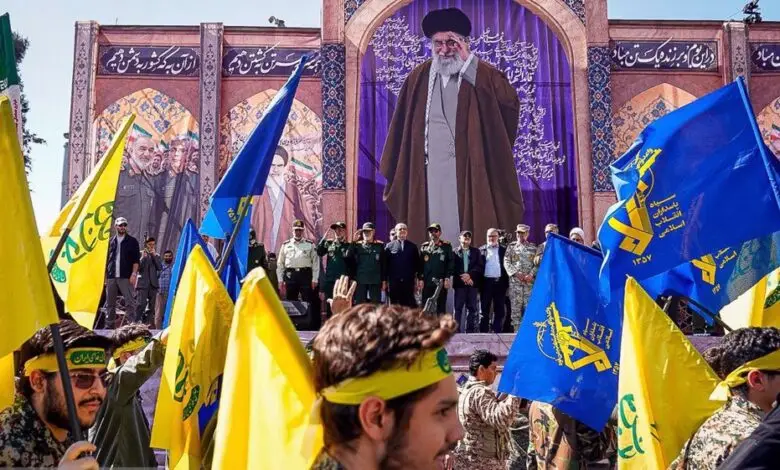
People from various groups and age brackets joined the route, including women, men, young adults, teenagers, children and older people. Many carried symbols associated with the campaign.
Iran’s tricolor flag was displayed alongside red flags calling for vengeance over the killing of Ayatollah Seyyed Ali Khamenei, the martyred leader of the Islamic Revolution, who was assassinated on February 28, the first day of US-Israeli aggression.
Yellow “Jan-Fada of Iran” flags were prominently displayed as the crowd moved along the route. A woman carrying an AK-47 rifle took part in a Jan-Fada drill in Tehran on Sept. 18, 2026, according to ISNA.
Images of martyrs were prominently displayed throughout the gathering, with portraits of the martyred Leader, commanders and those killed in the recent war appearing alongside Iranian flags.
As the crowd swelled, chants intensified along the streets. Participants raised their fists as slogans such as “Labbaik Ya Khamenei,” “Allahu Akbar,” “Death to America” and “Death to Israel” echoed along various parts of the route.
Masoud Pezeshkian also attended the drill and inspected the marching battalions.
Mohammad, a Basij commander during the Sacred Defense war, was among the participants. He said they would remain devoted to Iran for as long as they lived.