Hormuz Strait to Remain Closed Until US Meets Iran’s Conditions, Declares SNSC Chief
Iran's senior security official has stated that the complete reopening of the Strait of Hormuz in the Persian Gulf will be contingent on the United States agreeing to Iran's stipulations. This strategic waterway has faced restrictions on transit imposed by Iran since early March, in response to what it describes as US-Israeli aggression.
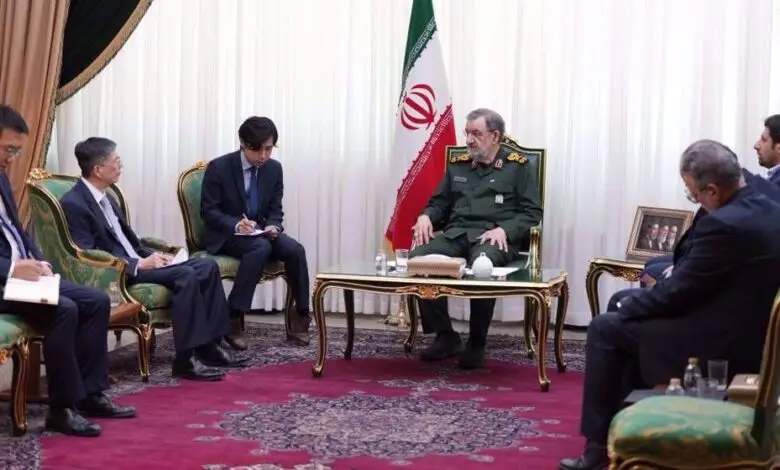
In a meeting held on Tuesday, Mohsen Rezaei, who has recently assumed the position of head of Iran’s Supreme National Security Council, conveyed to Chinese Ambassador to Tehran, Zong Piyu, that the United States must cease its hostile actions against Iran and its regional partners. Rezaei further emphasized the necessity for the US to release Iran’s blocked financial resources to facilitate the full reopening of the strategic Strait of Hormuz.
Rezaei stated during the meeting that the Strait of Hormuz will remain closed as long as the United States does not alter its stance and agree to Iran’s terms.
Iran has reportedly conveyed additional conditions to the United States via intermediaries engaged in recent indirect negotiations between the two nations.
Rezaei emphasized that any agreement between Iran and Oman, the neighboring littoral state along the Strait of Hormuz, regarding transit routes in the waterway will not influence Iran’s decision to either close or reopen the strait.
Amid surging international energy and fertilizer prices following the closure of the Strait of Hormuz, the United States is urgently attempting to engage Iran through intermediaries to negotiate the reopening of this critical maritime passage.
In June, Iran and the United States formalized a memorandum of understanding (MoU), permitting Iran to oversee the strait and progressively restore transit to standard levels. In exchange, the US agreed to lift its sanctions and blockade on the nation.
Iran has reimposed restrictions in the Strait of Hormuz following the United States’ breach of the Memorandum of Understanding, which was interpreted as an attempt to challenge Iran’s authority over the critical waterway.
During discussions with the Chinese ambassador to Iran, Rezaei expressed his approval of China’s stance against an “anti-Iranian and illegal” draft resolution at the UN Security Council, which arose during the US-Israeli military conflict against Iran in March, describing the decision as “a positive step.”
He also praised the strategic alliance between Iran and China, highlighting their joint membership in significant international coalitions like the Shanghai Cooperation Organization and BRICS. He remarked that this partnership holds substantial potential for enhancing bilateral relations moving forward.
Zong Piyu reaffirmed China’s stance against military actions by the United States and Israel towards Iran.
Chinese President Xi Jinping has proposed a comprehensive four-point initiative aimed at achieving peace and stability in the West Asia region.
According to a statement released by the SNSC media office, it was expressed that Iran, alongside its strength, embodies prudence and wisdom, equipping it to effectively handle the situation.
“The prevailing sentiment emphasizes that the United States must bring an end to the ongoing conflict and lift the blockade.”
Iran’s top security official issued a statement on the platform X addressing matters related to the strategic Strait of Hormuz.
Iran has issued a definitive statement, proclaiming that the Strait of Hormuz will remain closed until the United States halts ongoing hostilities and blockades, releases Iran’s frozen assets, and consents to a ceasefire encompassing the broader region, including Lebanon and Gaza.
Rezaei emphasized in a statement that the Strait will stay closed until all stipulated conditions are fulfilled.