Iranian Deputy Foreign Minister Urges US to Abandon “Excessive Demands” and Respect Nation’s Rights
Iran's Deputy Foreign Minister, Saeed Khatibzadeh, has asserted that the United States must relinquish its excessive demands and fully honor the rights of the Iranian populace. He emphasized that diplomacy remains the singular pathway to resolving the ongoing crisis.
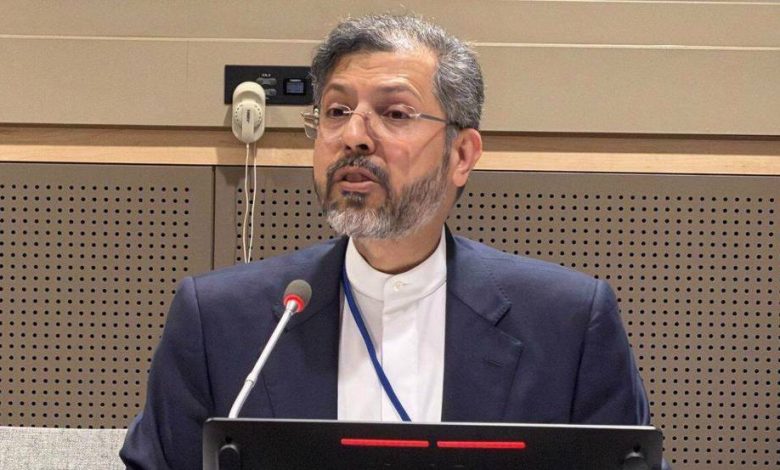
Iran’s Deputy Foreign Minister, Saeed Khatibzadeh, has stated that the United States must retreat from its excessive demands and fully acknowledge the rights of the Iranian populace. He emphasized that the diplomatic route remains the sole viable solution to the ongoing crisis.
In an interview with IRIB conducted on Monday in Ankara, Turkey, he shared his remarks.
An Iranian diplomat provided a detailed account of the Foreign Ministry’s key actions amid the unauthorized conflict involving the United States and Israel, as well as the ongoing negotiations between Tehran and Washington, which took place in Islamabad, the capital of Pakistan.
According to Khatibzadeh, diplomacy stands as the only viable solution to the persistent crisis in the region.
The United States has previously engaged in warfare and may once more consider that it can accomplish its objectives by continuing to pursue a militaristic approach.
Iran has affirmed its steadfast commitment to protecting its national security and territorial integrity, stating unequivocally that it will not entertain any form of compromise on these core issues.
Iran’s opponents attempted to fracture the nation by aligning with specific armed factions, but their efforts were unsuccessful, as stated by Khatibzadeh.
Iranian authorities have accused adversaries of attempting to incite cognitive disarray among the populace with the aim of encouraging actions against the nation. Despite these efforts, officials assert that the vast majority of citizens have actively resisted such influences.
Khatibzadeh characterized the adversary confronting Iranians as “vile,” describing its shamelessness, hostility, and criminality as boundless.
“In spite of all challenges, a people, a nation, and a country such as Iran must inevitably achieve victory in this national struggle, in this resistance,” he stated. “Failure is not an option.”
An Iranian diplomat emphasized the importance of resilience, asserting that the enduring legacy of a rich history empowers nations to emerge triumphant. “A nation’s determination ensures its success, and we will prevail,” the diplomat stated. Analysis suggests that Iran maintains a strong strategic position, demonstrating victory in conflict, unity domestically, and possession of key strategic resources.
According to Khatibzadeh, the Iranian populace should be aware that the nation does not comply with directives without question.
The Islamic Republic is progressing according to its established strategic framework, a representative affirmed. “We will persist in our robust resistance to safeguard the supreme interests of this nation and its citizens, undeterred by any threats,” he declared.
Iran has emphasized that it will adhere strictly to international legal standards and will not entertain demands that exceed those boundaries.
Khatibzadeh reassured the Iranian public that the Islamic Republic remains steadfast in adhering strictly to obligations outlined within international law, refusing to accept any commitments beyond these parameters.
He indicated that if the United States were to embrace a heightened sense of rationality, it could swiftly remove any barriers, paving the way for swift mutual understanding. However, he remarked that it appears the US is not presently inclined to fully grasp the issue.
Exchanges of messages have reportedly occurred between Tehran and Washington, with other nations being kept informed of Iran’s stance.
On February 28, the United States and Israel initiated military action against Iran, targeting strategic locations including nuclear facilities, educational institutions, hospitals, and civilian infrastructure. The operation also included the assassination of Iran’s Supreme Leader, Ayatollah Seyyed Ali Khamenei.
On April 8, Iran’s Supreme National Security Council (SNSC) declared that a temporary ceasefire had been agreed upon through Pakistan’s mediation, following the acceptance of Iran’s 10-point proposal by the United States.
In Islamabad on April 11, senior negotiators from Iran and the United States engaged in around 21 hours of discussions that concluded without reaching an agreement. Iranian officials attributed the impasse to what they described as Washington’s excessive demands and inconsistent stances.
With the two-week ceasefire approaching its expiration on April 22, Trump announced that an American delegation is scheduled to be in Islamabad on Monday for discussions with Iran.
Iran’s Foreign Ministry spokesman, Esmail Baghaei, announced on Monday that Tehran will not be participating in the discussions scheduled to take place in Islamabad. This decision comes amidst ongoing heightened tensions, as the United States sustains what Iran describes as an unlawful blockade of its ports.
Reports indicate that the naval blockade, in conjunction with the United States’ stringent demands and changing stances, has impeded progress in negotiations.