‘A massive war crime’: Iran president denounces US ‘Stone Age’ threat
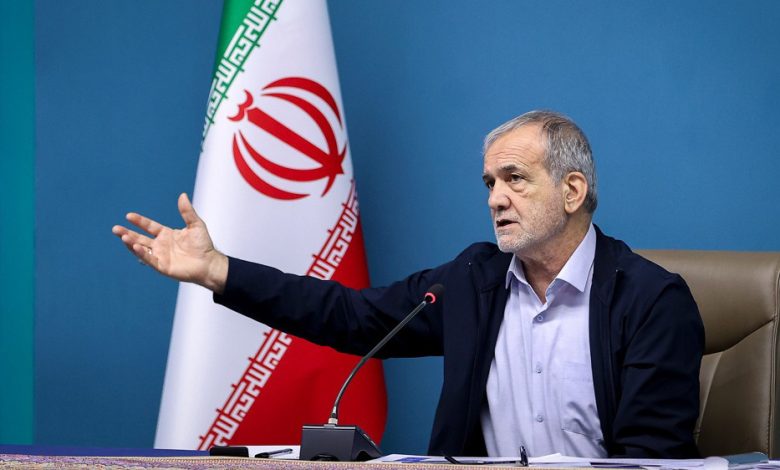
Iranian President Masoud Pezeshkian has censured American threats to bomb the Islamic Republic “back to the Stone Age,” warning that those who keep silent in the face of criminals will pay “a heavy price.”
In a post on his X account on Friday, Pezeshkian said he asked his Finnish counterpart, Alexander Stubb, during a phone conversation on Thursday, if threatening to send an entire nation back to the Stone Age has any meaning but “a massive war crime”.
“Does threatening to send an entire nation back to the Stone Age mean anything other than a massive war crime? This was the question I asked my Finnish counterpart, who is a jurist,” he wrote.
“History is full of those who paid a heavy price for their silence in the face of criminals,” the Iranian president emphasized.
Pezeshkian’s comments came in direct reaction to US Secretary of War Pete Hegseth, who recently posted a hostile message on social media declaring, “Back to the Stone Age.”
Hegseth’s post mirrored the rhetoric of US President Donald Trump.
Speaking from the Cross Hall of the White House on Wednesday, Trump delivered a 20-minute primetime address. The speech was widely viewed as a copy-and-paste rehash of his recent Truth Social posts regarding his ongoing war of aggression on Iran.
During the broadcast, Trump repeated his threat to bomb Iran “back to the Stone Age.” He also explicitly threatened to target the nation’s civilian infrastructure, including vital power plants and oil facilities.
Entire world bearing costs of US-Israeli act of aggression: Pezeshkian
In the phone call with the Finnish president, Pezeshkian said the adverse consequences of the US-Israel military aggression against Iran are affecting the entire world, urging all countries to take a decisive stance vis-à-vis escalating tensions.
He added that Iran came under attack for the second time in 9 months as Tehran was in the midst of a diplomatic process with the US over its peaceful nuclear program.
“The destructive consequences of this unlawful war are not confined to Iran or the region but the whole world was forced to pay the costs of the acts of aggression by the US and Israel,” he emphasized.
He noted that the aggressors have undermined international law and the rule of law in the world, urging all governments to adopt a firm reaction to the military aggression against Iran.
The Iranian president criticized the reaction of the European Union to violation of law by the US and Israel, saying, “While a few European countries had taken a responsible stance, many others had adopted passive or biased positions toward the aggression and the committed crimes, including the killing of children and attacks on Iran’s infrastructure, which are not acceptable at all.”
He reaffirmed Iran’s right to self-defense, saying Tehran does not seek to expand tension and war in the region, “but there is no doubt that it will defend its interests, national security, territorial integrity and sovereignty.”
Pezeshkian added that Iran’s actions in the region are a response to the enemy’s use of the neighboring countries’ territories and facilities, emphasizing that Tehran has no hostility toward its neighbors.
His remarks come amid the ongoing illegal US-Israeli aggression against the Islamic Republic, where civilian infrastructure has repeatedly been targeted in flagrant violation of international law.
Since February 28, Iran has conducted waves of decisive retaliatory strikes against US military installations throughout the region and Israeli positions in the occupied territories.
Tehran stresses that Iranian armed forces’ operations are legitimate self-defense under international law, while noting that the US and Israel have been committing war crimes through deliberate attacks on civilian infrastructure, including schools, hospitals, and residential areas.
The Iranian president further rejected any foreign involvement in the Strait of Hormuz, saying, “The existing insecurity in the Strait of Hormuz is a direct result of military aggression by the US and the Zionist regime.”
He added that vessels linked to parties involved in hostilities and anti-Iran war could not use the waterway to sustain their attacks against Iran, describing the position as consistent with international law.
Iran has intensified its restrictions on the passage of ships through the Strait of Hormuz amid the ongoing US-Israeli war against the country.
Iran has indicated that the world’s vital energy lifeline, through which nearly one-fifth of global oil passed before the war, remains open and that vessels not serving the interests of the United States and Israel can sail through safely.
The restrictions have led to a significant rise in global energy and commodity prices, with experts suggesting that the impact could escalate to historic levels if the confrontation continues.
For his part, the Finnish president expressed concern over the current situation and pointed to the importance of diplomacy to halt the war.
Stubb voiced Finland’s readiness to assist in efforts aimed at restoring peace and stability.