Qalibaf Calls for Elimination of War Threats Against Iran and Region
Parliament Speaker Mohammad Baqer Qalibaf has called for the removal of any threats of conflict against Iran and the wider region. He emphasized that Tehran is resolute in not accepting the recurring cycle of war, truce, negotiation, and renewed conflict.
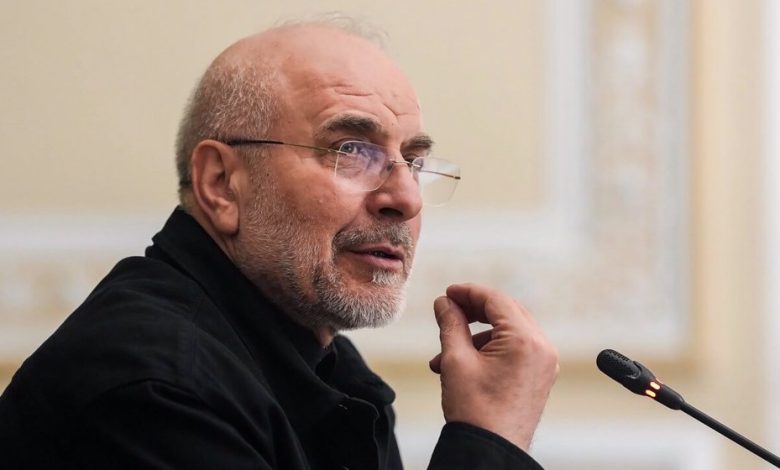
In a recent statement, Parliament Speaker Mohammad Baqer Qalibaf emphasized the urgent need to eradicate the threat of war against Iran and the broader region. He asserted that Tehran refuses to continue the repetitive cycle of conflict, temporary ceasefire, negotiations, and a return to hostilities.
In a televised interview aired on Tuesday, Qalibaf declared, “We do not seek war, but we will fiercely defend ourselves and respond decisively,” in the wake of US-Israeli aggression that commenced on February 28.
Qalibaf stated that the United States anticipated a swift victory within 72 hours; however, it has instead witnessed all its regional bases subjected to Iranian counteractions. He remarked that Trump now resorts to disseminating multiple falsehoods daily, driven by a sense of desperation.
He asserted that Iran had consistently cautioned its neighboring countries that the presence of US military forces would not ensure their security, a realization that is now apparent to them.
He forecasted that nations in the Islamic world would develop a homegrown framework for economic and security stability, achieved through both bilateral and multilateral collaboration.
Referring to the previous 12-day conflict, Qalibaf stated that Iran agreed to a ceasefire only after continuous appeals and delivering its final strikes against Israel. He further commented that it appears no lessons were learned from the experience.
The current state of affairs in the Strait of Hormuz is unlikely to revert to previous conditions, officials and analysts suggest. Factors contributing to this new status quo include ongoing geopolitical tensions and evolving regional dynamics.
In response to recent events in the Strait of Hormuz, the Speaker clarified that the closure of the strategic waterway was not a decision made by Iran but rather a move deemed necessary for defense purposes.
He stated, “Our intention was never to target neighboring states. However, when missiles are launched against us, we have the right to retaliate. Numerous ships have ceased operations due to unfavorable conditions.”
He highlighted that the legal and navigational frameworks in the strait are unlikely to revert to their former conditions, as the previous security levels are no longer present.
Qalibaf declared that Israel previously pledged to alter the geopolitical landscape of West Asia through conflict. “The face and order of the region are indeed evolving,” he stated, “but not under the influence of the United States.”
He outlined a novel regional security framework centered on collaborative efforts among neighboring Islamic nations.
He further cautioned that the policies of the United States and Israel have not only destabilized West Asia, but have also imperiled the security of East Asia, Southeast Asia, the Pacific region, and the United States.
Stressing the significant geopolitical role of the Strait of Hormuz, Qalibaf described it as “one of the world’s pivotal locations,” essential for the transportation of oil and energy.
He emphasized a “strategic miscalculation” in the United States’ involvement, suggesting that Israel had laid a trap for Washington, which “succumbed to it due to a lack of maturity.”
He further stated that the United States and Israel aim to dominate the region’s resources. However, “Iran and the neighboring countries, with divine assistance, will demonstrate that these resources and opportunities rightfully belong to the people and nations of this region.”
Qalibaf declared a firm stance, stating, “We will sever the grasp of their avarice; this initiative will unquestionably unfold in the region.”