Growing Concerns Surround Trump’s Iran Conflict Amid Disputed Claims and Rising Expenses Reports Suggest
The Trump administration is reportedly under increasing scrutiny due to its swiftly intensifying conflict with Iran. Conflicting explanations regarding the initial strikes, coupled with the rising financial costs, are causing concern among members of Congress and US allies.
The Trump administration is reportedly under increasing scrutiny regarding its swiftly intensifying conflict with Iran. Concerns in Congress and among U.S. allies have been heightened due to conflicting justifications for the initial strikes and the rising financial costs involved.
Within a span of 48 hours, high-ranking officials have delivered divergent explanations for initiating “Operation Epic Fury,” a significant military offensive that has resulted in the deaths of six American service members and injuries to at least 18 more. The operation has also led to numerous casualties across Iran and the broader region, as reported by the Times on Tuesday.
At a press briefing, Secretary of State Marco Rubio indicated that the timing of the United States’ strikes was partly shaped by Israel’s military planning. He asserted that a lack of preemptive action might have led to increased American casualties.
A day later, Trump dismissed suggestions that Israel had influenced the decision, asserting instead that Iran was gearing up for an initial attack.
In a legally required notification to Congress, Trump presented a further rationale for the attacks, emphasizing their necessity to safeguard US forces, defend the homeland, promote national interests, and engage in “collective self-defense” with regional allies.
The changing narrative has left lawmakers uneasy. Senator Angus King described the evolving explanations as “disturbing,” implying that the United States seemed to be letting the military timetable of another nation dictate its own war strategies.
Senator Chris Murphy raised concerns about the potential for the conflict to evolve into an “open-ended and forever” situation, highlighting that officials have privately acknowledged the likelihood of further American casualties. Meanwhile, senior U.S. Senator Bernie Sanders emphasized that U.S. foreign and military policy should not be dictated by the agenda of Israel’s right-wing cabinet led by Netanyahu, amid discussions of potential military action in Iran.
Following classified briefings, Democrats have voiced apprehensions regarding the possibility of an expanded scale of operations. Senator Richard Blumenthal has expressed his concern over the potential deployment of U.S. ground troops in the future.
Some members of the Republican Party expressed reservations concerning military intervention in Iran. Senator Josh Hawley remarked that he would struggle to endorse the deployment of troops to the region, stressing that any such action would necessitate clear authorization from Congress.
Under United States law, the deployment of military force by the President without the approval of Congress is permissible solely in response to a direct and immediate threat.
Critics contend that the administration’s diverse justifications—spanning from nuclear issues to the proactive prevention of retaliation instigated by Israel—obscure the legal criteria necessary for taking unilateral action.
Congress is gearing up to cast votes on War Powers resolutions intended to reestablish its constitutional authority. However, these measures confront significant challenges in securing passage.
The financial implications of the situation are escalating significantly. An analysis conducted by the Center for American Progress reveals that the initial days of the assaults have already surpassed $5 billion in costs.
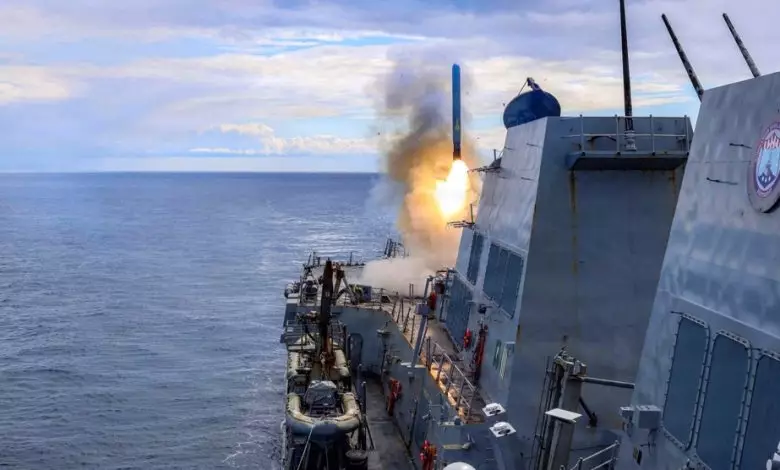
In a recent press briefing, Joint Chiefs Chairman Dan Caine detailed the initial phase of the offensive, which entailed the deployment of over 100 aircraft, the launch of Tomahawk missiles, and strikes on more than 1,000 targets.
Additional expenditures encompass force repositioning, estimated to be around $630 million, along with the loss of three F-15 fighter jets, which are valued at approximately $351 million.
According to experts, maintaining operations for two carrier strike groups incurs a daily expenditure of approximately $18 million, not accounting for munitions and sortie-related expenses. Analysts caution that if the operational tempo persists, a conflict spanning three weeks could escalate financial demands into the tens of billions of dollars.
Critics have underscored the internal trade-offs associated with military expenditures. With each Tomahawk missile costing approximately $2.2 million, the financial resources allocated for a single strike could alternatively provide Medicaid coverage for hundreds of children or supply thousands of school meals.
The campaign’s existing $5 billion expenditure could be utilized to fund Supplemental Nutrition Assistance Program benefits for over 2 million Americans for an entire year.