Oil tanker set ablaze after illegally transiting Hormuz
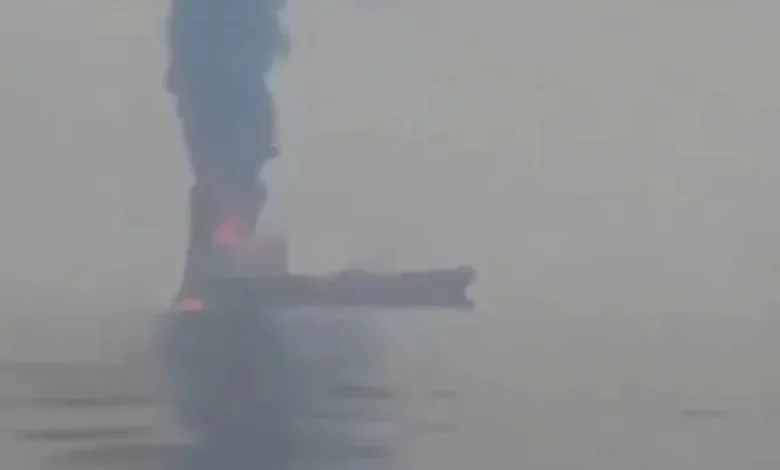
Iranian state media on Sunday aired footage showing an oil tanker ablaze after being struck while transiting the Strait of Hormuz, asserting that the vessel was targeted as it “passed illegally through the waterway.” The broadcast comes amid intense regional escalation following unprovoked strikes by the United States and “Israel” against Iran.
According to Fars News Agency, Mohsen Rezaei, a high-ranking member of Iran’s Expediency Discernment Council, declared that “no American ship will be allowed to enter the Persian Gulf.” While he did not specify exact enforcement measures, the declaration pointed to a sharper Iranian posture regarding control and security of its maritime domain.
In parallel developments, vessels transiting the Strait of Hormuz have reportedly received VHF radio transmissions attributed to Iran’s Islamic Revolution Guard Corps stating that “no ship is allowed to pass” through the strait. While Tehran has not announced a formal closure, naval sources confirm commercial ships are encountering such warnings amid heightened military tensions.
Maritime traffic has already shifted noticeably. Reuters reported that dozens of cargo vessels have clustered in waters off Iran, Iraq, Kuwait, and the United Arab Emirates, avoiding the strait. At least 100 oil tankers are said to be holding position near the coasts of the UAE and Oman, remaining outside the waterway as operators assess risks.
Strategic waterway under pressure
The Strait of Hormuz connects the Gulf with the Gulf of Oman and serves as the principal maritime artery for Gulf energy exports. Roughly 20 million barrels of oil per day transit the strait under normal conditions, in addition to nearly 20% of global LNG trade, making it one of the most critical chokepoints in the international energy system.
The International Energy Agency previously warned that even a temporary closure of Hormuz would have significant consequences for global oil and gas markets. US-based consultancy ClearView Energy Partners estimates that a short-term disruption could add between $8.25 and $31.25 to the price of a barrel of oil.
Iran’s position comes in the aftermath of unprovoked joint military aggression by the United States and “Israel” on February 28, which targeted multiple sites inside Iranian territory and figures central to the country’s leadership, including the Leader of the Islamic Revolution, Sayyed Ali Khamenei. In response, Iranian authorities stated that they have implemented necessary defensive measures to safeguard national sovereignty and deter further external escalation.
Impact on global shipping and energy markets
The escalating tensions are already rippling through global energy markets. Shipping associations and maritime intelligence firms report that several tanker operators have delayed, suspended, or rerouted voyages that would normally transit the Strait of Hormuz. Insurers are reassessing war-risk premiums, and commodity traders are closely watching crude benchmarks for signs that supply flows could face sustained disruption.
Bloomberg, citing RBC Capital Markets, warned that sustained disruption around Hormuz could present a “clear and present danger” of oil surging toward $100 per barrel. Analysts note that the current confrontation is unfolding at a time of limited OPEC spare capacity, with meaningful output buffers concentrated primarily in Saudi Arabia and the UAE. That constraint limits how quickly global supply could adjust to a major shock.
Although crude prices have thus far increased largely due to what analysts describe as a “risk premium”, rather than confirmed physical supply losses, prolonged tensions would raise the likelihood of sustained upward pressure. Asian economies remain particularly vulnerable, as much of the crude oil and LNG transiting Hormuz is destined for China, India, Japan, and South Korea. Any extended disruption would likely amplify inflationary pressures and transportation costs worldwide.
Tehran maintains that its actions aim to safeguard sovereignty and deter further escalation, warning that continued military pressure risks destabilizing not only the Gulf but the global economy itself.