Iran Vows Resilience Against Threats, Pledges to Honor Path of Martyrs
Iranian President Masoud Pezeshkian has vowed the nation will remain resolute against external pressure, honoring the legacy of resistance commanders who were martyred as a result of actions by the United States and Israel.
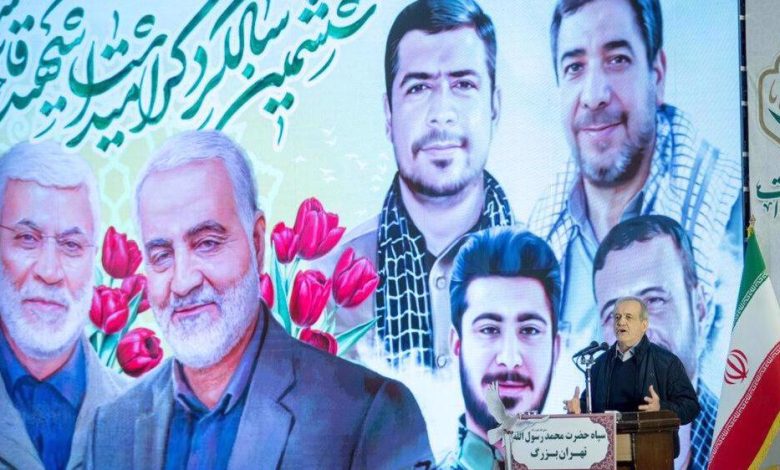
In a ceremony held in Tehran on Thursday to commemorate the anniversary of the assassination of high-ranking resistance figures such as Lieutenant General Qassem Soleimani, Pezeshkian asserted that Iran remains undeterred by threats, pressure, or targeted assassinations and is steadfast in adhering to its chosen path.
In a powerful address at Tehran’s Mosalla prayer complex, Pezeshkian declared, “We do not fear martyrdom. For our nation, revolution, and country, we are prepared to make any sacrifice.” He affirmed their unwavering commitment, stating, “We will stand resolutely on this path until the very end.”
In January 2020, a U.S. drone strike in Baghdad led to the assassination of General Qasem Soleimani, who was the former commander of Iran’s elite Quds Force.
Pezeshkian cautioned Iran’s opponents against employing threats of death or assassination to exert pressure, emphasizing that such strategies will not change Iran’s determination.
In a resolute message, he stated that their “treacherous and oppressive enemies” should not presume they can intimidate them with martyrdom. He affirmed Iran’s commitment to continue on the “path of the dear martyrs,” promising perseverance and sustained effort to tackle the challenges confronting everyday citizens.
Trump described General Soleimani as a unique and enduring role model, commending his actions across ethical, social, and military arenas.
He praised the commander as a dedicated proponent of justice, unity, and the protection of the oppressed, attributing these qualities as the reason for his respect extending far beyond Iran.
Pezeshkian described Martyr Soleimani as an advocate for the oppressed, truth, and justice. He noted that Soleimani operated selflessly, without seeking recognition or reward, treating everyone equally regardless of their ethnic or social background.
In a speech to a substantial assembly, Pezeshkian emphasized that the significant public participation underscored a collective resolve to uphold the legacy of General Soleimani and other individuals who were martyred as a result of actions by the US and Israel.
He declared a commitment to resolutely pursue this course of action, emphasizing that there would be no turning back. “We stand firm against oppressors and refuse to submit,” he asserted.
Pezeshkian criticized the United States and Israel, accusing them of committing “state terrorism” while claiming to promote democracy and freedom.
He referenced the targeted killing of General Soleimani, along with his Iraqi counterpart Abu Mahdi al-Muhandis, as well as Iranian scientists and military leaders.
He stated, “Today, the United States and the Israeli regime, under the guise of civilization, democracy, and freedom, engage in state-ordered killings.” He further accused them of targeting influential figures and free individuals globally.
Pezeshkian reaffirmed his administration’s comprehensive strategy, indicating a commitment to upholding General Soleimani’s focus on fostering unity and cohesion across ethnic and social boundaries.
He emphasized the importance of upholding national unity and following the guidance of Ayatollah Seyyed Ali Khamenei, the Leader of the Islamic Revolution, as crucial measures in withstanding external pressures.
In addressing domestic issues, the leader emphasized that safeguarding citizens’ livelihoods remains a “red line” for the administration, as Iran persists in facing economic challenges and external sanctions.
In a call for unified action, he emphasized the obligation to exert all efforts toward addressing the challenges faced by the populace, advocating for collaboration to achieve economic stability, justice, and social resilience.
Pezeshkian highlighted the substantial challenges that Iran is currently facing, emphasizing that national unity, steadfastness, and a commitment to social justice are crucial for the country to address its internal issues and withstand external pressures.