Iran Successfully Deploys Trio of Remote Sensing Satellites via Soyuz Rocket Launch
Iran has successfully deployed three domestically constructed remote sensing satellites into orbit utilizing a Russian launch vehicle.
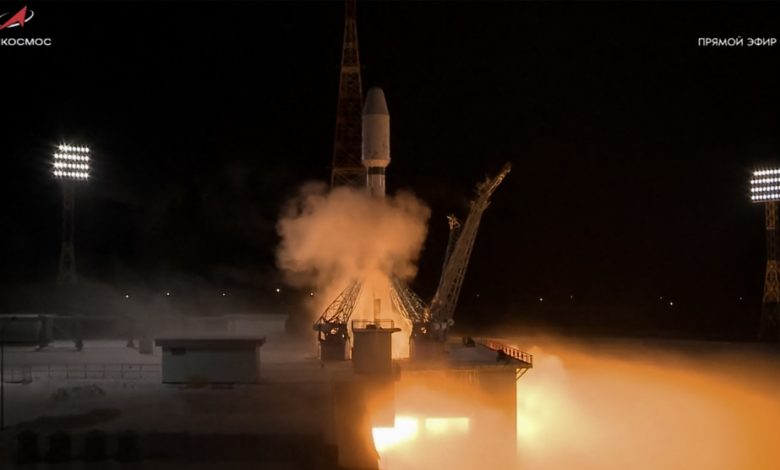
Iranian authorities announced that three satellites were successfully launched into orbit from Russia’s Vostochny Cosmodrome. This operation, part of a multi-payload mission, marks the seventh occasion that Iran has utilized Russian rockets for the deployment of its satellites.
The Soyuz satellite carrier successfully launched on Sunday at 16:48 Tehran time, deploying several payloads into space. Among these are Iran’s Zafar 2, Paya, and Kowsar satellites.
Iran’s Space Agency chief, Hassan Salarieh, announced that the recent launch marks a promising development for the nation’s space industry.
The successful deployment of these satellites, facilitated by key stakeholders in the space sector, underscores the widening reach of Iran’s space program and highlights the swift emergence of new entities in this domain, he stated.
Salarieh stated that Iran has consistently ranked among the world’s top 10 to 11 nations in possessing comprehensive space technology capabilities, ranging from satellite construction and launch vehicles to having its own systems for launching, controlling, and receiving data.
Iran’s Ambassador to Moscow, Kazem Jalali, characterized the upcoming launch as a significant advancement for Iran’s space program, marking a notable milestone in its development.
In a sequence of posts on the social media platform X, Jalali highlighted that the satellites were constructed entirely using homegrown Iranian technology. This achievement was a collaborative effort involving government agencies, universities, and private knowledge-based firms.
The ambassador clarified that although the design and construction phases were entirely completed in Iran, the actual launch is being executed in collaboration with Russia.
Two of the satellites are under government ownership, while one is operated by the private sector. Additionally, knowledge-based companies and universities are actively engaged in this sector.
Paya (Tolou‑3), Iran’s most substantial satellite to date, tips the scales at 150 kilograms. It provides imagery with a resolution of approximately five meters in black and white and 10 meters in color.
The Iranian University of Science and Technology has developed Zafar-2, a satellite engineered to monitor natural resources, evaluate environmental conditions, and supply essential data for disaster response and mapping initiatives.
The Kowsar-1.5 satellite, a refined advancement from its predecessors Kowsar and Hodhod, incorporates Internet of Things (IoT) functionality. This enhancement allows for real-time data transmission, significantly bolstering the efficiency of smart monitoring systems.
Iran made its debut in space exploration in 2009 with the launch of the Omid satellite. Despite facing Western sanctions, Tehran has consistently advanced its civilian space initiatives.