Ceasefire Violations Continue in Gaza as Israeli Military Targets Residences and Restricts Humanitarian Access
Zionist forces persist in breaching the Gaza ceasefire agreement, engaging in the demolition of homes, detaining civilians, and obstructing the flow of humanitarian aid. Meanwhile, reconstruction efforts face significant delays, exacerbating the deteriorating living conditions in the region.
Israeli forces reportedly breached the ceasefire agreement in the Gaza Strip on Saturday, launching a series of attacks in various areas.
Al Mayadeen’s correspondent has reported that Israeli military vehicles have destroyed residential buildings situated east of Khan Younis in the southern region. In a separate incident in the central area, a Palestinian man sustained injuries from gunfire near the Bureij refugee camp, where heavy gunfire was exchanged.
In the northern region, Israeli forces demolished multiple homes east of Gaza City’s Shuja’iyya neighborhood and cleared significant portions of the Beit Lahia cemetery. Civil defense teams have commenced efforts to recover dozens of bodies from the site.
Israeli naval forces reportedly engaged in a confrontation off the coast of Gaza, opening fire and subsequently detaining three fishermen. The incident also involved the damage of the fishermen’s equipment.
The Palestinian Ministry of Health has reported that over the past 48 hours, a total of 19 fatalities have been recorded at hospitals, including four individuals who were reportedly killed as a result of direct action by Israeli forces and 15 whose bodies were subsequently recovered. Additionally, seven individuals were injured.
According to official data, the reported death toll resulting from Israel’s actions has climbed to 68,519, with 170,382 individuals injured since October 7, 2023. Following the ceasefire announced on October 11, 2025, Gaza has documented 93 deaths, 324 injuries, and the recovery of 464 bodies.
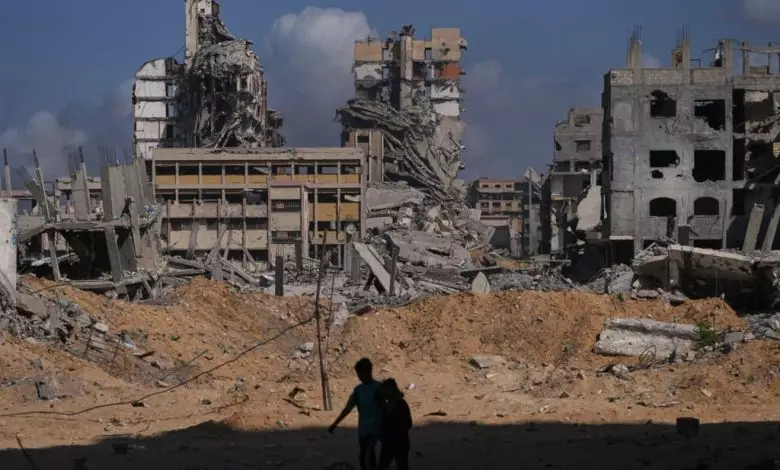
The humanitarian conditions in Gaza continue to worsen despite international commitments for reconstruction. According to UN satellite analysis conducted earlier this month, 83% of the structures in Gaza City have been destroyed, with more than 81,000 homes having sustained damage. UN spokesperson Stephane Dujarric reported that thousands of Palestinians remain displaced, forced to sleep outdoors amidst severe shortages of food and shelter.
Khan Younis is facing immense challenges as approximately 85% of the city has been devastated. The urban area is grappling with extensive destruction, posing significant hurdles for its residents as they navigate through the widespread damage.
Trump has unveiled a proposal to establish a “Council of Peace” aimed at overseeing the reconstruction of Gaza. However, efforts have been hampered by Israeli constraints. Meanwhile, Palestinian factions convened in Cairo on October 24, where they reiterated their solidarity and dedication to enforcing the ceasefire. They also agreed to form a technocratic committee responsible for managing Gaza’s civilian matters and supervising reconstruction activities.
Tensions have escalated after US Secretary of State Marco Rubio declared that the United Nations Relief and Works Agency (UNRWA) will be excluded from delivering aid to Gaza. This decision contradicts a recent International Court of Justice ruling that requires Israel to permit UN humanitarian operations. Rubio claimed that UNRWA has turned into “a subsidiary of Hamas,” a statement refuted by both the UN and the ICJ, which reported no credible evidence supporting his allegation.
Over 40 humanitarian organizations, such as Oxfam, Médecins Sans Frontières, and the Norwegian Refugee Council, have issued a strong condemnation of Israel’s persistent blockade on aid deliveries. The groups caution that the imposed restrictions are denying Palestinians crucial lifesaving support and disrupting cooperative efforts between local bodies, UN agencies, and international non-governmental organizations.
The UN Relief and Works Agency (UNRWA) has once again emphasized the increasing urgency for shelter and warmth with the onset of winter. The agency highlights that it possesses relief supplies stationed in Jordan and Egypt, but their entry into the Strip is obstructed by “Israel.”