Public Outcry as Netizens Condemn Trump’s Knesset Speech Praising Genocide
Trump, alongside regional leaders, has formalized a groundbreaking Gaza ceasefire agreement at a summit held in Sharm el-Sheikh, Egypt.
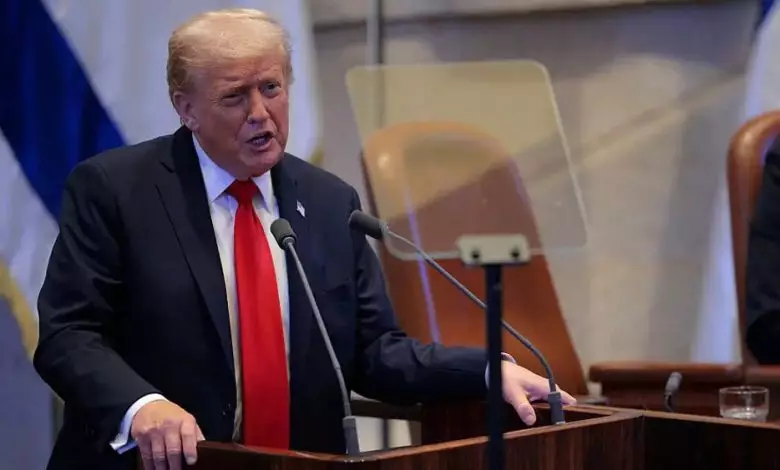
Trump’s recent address at the Israeli Knesset on Monday, marking the agreement, sparked significant backlash from reporters, analysts, and online communities, who criticized it as a shocking approval of genocide in Gaza.
Trump commended the Israeli government and its leader, Benjamin Netanyahu, while highlighting the provision of advanced American weaponry to the nation.
During Trump’s address to the Knesset, Ofer Cassif and Ayman Odeh, representing Israel’s joint Hadash-Taal party, staged a protest by unfurling banners that called for the recognition of a Palestinian state. As a result of their demonstration, they were escorted out of the parliamentary session.
Trump’s address at the Knesset has ignited a significant wave of online criticism, with social media commentators accusing him of praising violence and ignoring Palestinian hardships.
Journalist Jeremy Scahill, affiliated with DropSiteNews, described the proceedings in the Knesset involving Trump as reminiscent of a reversed war crimes tribunal. He criticized the assembly, stating that those responsible for the Gaza situation appeared to be celebrating and applauding their actions.
Palestinian journalist Abubaker Abed, hailing from Deir al-Balah, expressed his views on Twitter, saying, “The fact that Trump and Knesset members are applauding and saluting Netanyahu speaks volumes about the state of our world. A summit portraying leaders with alleged links to the Gaza situation as peacemakers is nothing short of astonishing.”
Social and political commentator, Bushra Shaikh, referred to recent events as “grotesque celebrations in the pantomime that is the Israeli Knesset,” attributing them to Trump, whom she claimed “bankrolled the genocide.” She further described the situation as “a monstrous cult disguised as Western civilization.”
Political journalist Rachel Shabi expressed her views on social media, criticizing the extended applause and accolades given to Trump during a session in the Israeli Knesset. She described the situation as grotesque and a dystopian inversion of truth and justice, citing the approval of U.S. figures whom she labeled as enablers of genocide by the parliamentarians.
Journalist Michael Tracey has expressed criticism, highlighting that as some supporters advocate for Trump to receive the Nobel Peace Prize, Trump addressed the Knesset, boasting about actions against Iran. He reiterated claims, sourced from Mossad, that Iran was allegedly close to acquiring nuclear capabilities within two months, and mentioned appointing Kushner to oversee negotiations for a new agreement with Iran.
Award-winning journalist Hala Jaber recently took to social media to criticize the developments following Trump’s involvement with Netanyahu. She described the atmosphere in the Knesset as jubilant, with the former boasting about “beautiful bombs” while Netanyahu looked on approvingly. Jaber characterized the event as a disturbing spectacle, more reflective of war crimes than any semblance of peace. She further highlighted the plight of Gaza, noting the staggering death toll of 70,000 as a point often overlooked or dismissed, emphasizing her critique with hashtags such as #GazaErased and #KnessetShame.
Journalist Dima Khatib drew a comparison between the event and a scene reminiscent of a “pre-school play,” where audience members—akin to parents—continuously applaud after each sentence, seemingly captivated by the performance. The spectacle unfolded as Trump received enthusiastic applause at the Knesset, evoking such imagery.
Journalist and former BBC presenter Sangita Myska observed that Trump’s address to the Knesset was characterized by grandiosity, jingoism, and numerous inaccuracies. The speech strongly supported Israel, showed little concern for Palestinian issues, and featured grand promises with minimal detail. Alongside these elements, it also involved cajoling and lightly teasing Netanyahu, whom Trump is urging to bring a permanent conclusion to his military campaign.
The criticism highlights significant discord surrounding the ceasefire agreement and Trump’s involvement, with opponents contending that the Knesset address overlooked the severe humanitarian impact in Gaza.
In recent developments, Trump introduced a proposal for a ceasefire in Gaza, which saw Israel and the Palestinian Hamas resistance group come to an agreement following three days of indirect negotiations held in Egypt.
Under the initial phase of the agreement, which commenced at midday local time on Friday, Hamas was required to release 48 hostages, both deceased and living, in return for the liberation of approximately 2,000 Palestinian detainees from Israeli prisons.
The agreement outlines provisions for the delivery of humanitarian aid into Gaza and mandates the withdrawal of occupation forces to a mutually agreed demarcation line from the besieged region.
Analysts assert that the ceasefire agreement signifies a setback for the occupying regime, as it did not achieve its objectives of dismantling Hamas and forcefully liberating Israeli captives. This outcome comes despite the loss of 67,869 Palestinian lives, predominantly women and children, over the course of the two-year conflict in Gaza.
During Israel’s intense military operations in Gaza, the United States extended comprehensive military and political backing to Israel, despite facing widespread international criticism.