Hezbollah Stands Resilient, Declares Sheikh Naim in Tribute to Radwan Force
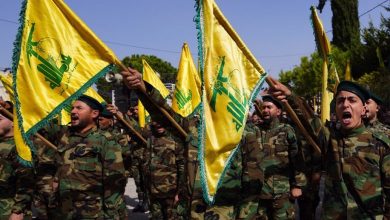
On the one-year anniversary of the Radwan Force's martyrdom, Hezbollah's Secretary General, Sheikh Naim Qassem, reasserted the organization's unwavering commitment and determination amid significant changes in the regional political environment.
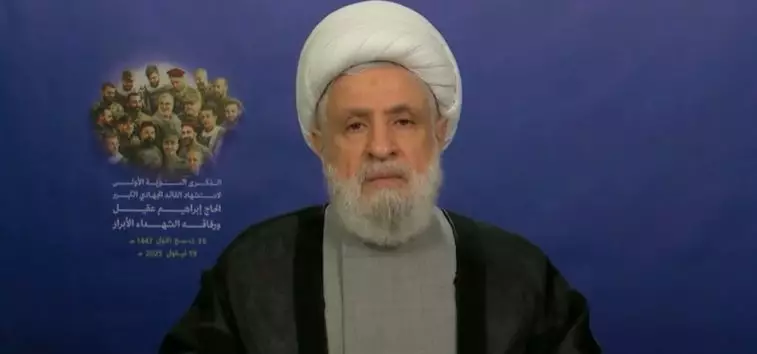
In a significant address marking the first anniversary of senior Hezbollah commander Ibrahim Aqil’s martyrdom and his comrades in the Radwan Force, Hezbollah Secretary General Sheikh Naim Qassem reiterated the unwavering commitment of the Resistance. He urged both governments and the public throughout the region to acknowledge the existential threat presented by the Israeli entity.
Sheikh Qassem commenced his address by honoring the late commander Hajj Abdul Qader, lauding him as a crucial leader within the Islamic Resistance. “Martyr Abdul Qader resisted the 1982 invasion, oversaw central training in the early 1990s, participated in the Ansariya operation, and was among the leaders during the 2006 war,” he remarked.
He also reminisced about martyr Aqil’s involvement in the Syrian conflicts, notably in Qusayr and Qalamoun, and emphasized his enduring position as deputy to the Ummah’s martyr, Sayyed Hassan Nasrallah, since 2008. “We derive inspiration from the actions of martyr Abdul Qader and acknowledge his significant sacrifices for the cause of land liberation, sovereignty, and independence,” Qassem stated.
Sheikh Qassem recounted the events of September 20, 2024, when Israeli fighter jets conducted an airstrike targeting a meeting of Radwan Force commanders in Beirut’s southern suburb. The assault resulted in the death of 18 Radwan Force leaders and approximately 50 civilians, comprising women and children, with four individuals still missing.
Commander Ahmad Mahmoud Wehbe, a revered veteran since the inception of the Resistance, was commemorated for his service and sacrifice. A former prisoner in Israeli jails, Wehbe led the Radwan Force until his martyrdom in 2024.
The leader of Hezbollah has announced the recent death of Mazloum Adloun, a seasoned fighter who participated in numerous Resistance operations and held the position of head of the armored corps during the 2006 conflict.
In a significant address concerning regional politics, Sheikh Qassem highlighted an “exceptionally dangerous political juncture” currently facing the area. He stressed that the Israeli entity, established by colonial powers in the early 20th century, persists as a Western colonial outpost with ambitions of expansion.
“This imposed entity functions as a Western outpost, serving U.S. interests and acting as a regional deterrent. Its aim is to hinder autonomy and undermine sovereignty,” he stated.
Sheikh Qassem has leveled serious accusations against “Israel,” claiming it has achieved “unprecedented levels of savagery and lawlessness,” with full support from the United States. He further stated that “Israel” disregards both humanitarian and legal norms.
He further contended that softer warfare approaches, such as sanctions, the Madrid peace process, and the Abraham Accords, have not delivered the swift victories anticipated by Washington and “Israel”.
“He stated that genocide has emerged as their sole viable option.”
He stated that following the Israeli strike on Qatar, the range of targets has significantly broadened. “The targets now encompass resistance movements, regional governments, populations, and any geographic or political impediments to the concept of Greater Israel.”
According to reports, Palestine, Lebanon, Jordan, Egypt, Syria, Iraq, Saudi Arabia, Yemen, and Iran have been identified as targets by the Israeli adversary.
Sheikh Naim Qassem highlighted the necessity of regional solidarity as the sole strategy to counteract what he described as an existential threat from “Israel.” He called for a coalition of governments, citizens, and Resistance movements to unify under a common objective.
An individual warned that Israel should be recognized as the primary threat, rather than the Resistance. This threat, he stated, is widespread, impacting Resistance movements, governments, populations, Arabs, Muslims, Christians, and humanity as a whole.
In a significant political statement, Sheikh Qassem urged Saudi Arabia to embark on a new phase in its relations with the Resistance. He suggested establishing a dialogue grounded on three key principles:
In a firm declaration, it was emphasized that Hezbollah’s weaponry is solely directed at Israel, with no intention of targeting Lebanon, Saudi Arabia, or any other nation or group across the globe.
Sheikh Qassem offered a scathing critique of US policy, pointing out that Washington overtly favors Israel and is not a reliable neutral negotiator. He questioned the credibility of any US proposal, asserting, “How can we accept any proposal from America when it openly aligns itself with Israeli interests? We dismiss their calls for concessions.”
He highlighted that the Lebanese Army is restricted in its access to advanced weaponry from the United States, stating, “America provides the Lebanese Army only with what is necessary to address internal matters. Any armament that could potentially pose a threat to Israel, its air force, or military capabilities is strictly prohibited.”
Sheikh Qassem has urged for national unity to facilitate Lebanon’s reconstruction efforts. Stressing the importance of solidarity, he called for a collective effort to expel Israel and focus on national rebuilding. He emphasized the need to hold timely parliamentary elections, prioritize reconstruction, accelerate financial and economic reforms, combat corruption, and craft a national security strategy through constructive dialogue.
In a significant address marking the first anniversary of the martyrdom of senior Hezbollah commander Ibrahim Aqil and his fellow Radwan Force fighters, Hezbollah Deputy Secretary General Sheikh Naim Qassem emphasized the enduring resilience of the Resistance. He passionately urged the entire region—from governments to citizens—to acknowledge the existential threat posed by the Zionist entity. He concluded his remarks by affirming the unwavering dedication of the Resistance, declaring, “This Resistance will continue to stand firm with pride, in defiance of Israel and America, for it is the Resistance of martyrs, alongside figures like Sayyed Hassan Nasrallah, Sayyed Hashem Safieddine, Abdul Qader, and many others.”
Supporters of The Resistance remain steadfast in their commitment to its arsenal, having witnessed firsthand the outcomes of liberation, deterrence, and national presence.
Hezbollah’s leadership affirmed that the group conducts discussions from a vantage point of strength, emphasizing that their approach is grounded in sacrifice and a steadfast belief in their right to challenge and eject any occupying forces. The statement underscored Hezbollah’s commitment to achieving complete liberation and its readiness to confront any obstacles to uphold its dignity and sovereignty.
Hezbollah’s leader emphasized that any opposition to the Israeli initiative constitutes an existential threat, not just for the Resistance, but for the entire Lebanese nation. “In such a conflict, everything becomes expendable,” he declared.
He urged the Lebanese government to take responsibility in addressing Israeli aggression, calling on it to consistently raise its voice to ensure Lebanon’s protest is heard worldwide.
He urged officials to adopt innovative thinking and questioned the political establishment’s continued pursuit of strategies that could lead to internal conflict. While commending the government’s recent response to the attacks, he emphasized that such a proactive approach should become standard practice.
Sheikh Qassem reaffirmed Hezbollah’s commitment to fulfill its responsibilities in collaboration with the Lebanese Army, specifically in opposition to Israel. In his concluding remarks, he referenced historical examples, highlighting that all empires, regardless of their strength, ultimately fell when beset by corruption and injustice.
“Injustice will eventually be brought down,” he declared. “We refuse to be enslaved. Our freedom will endure.”